
Technology continues to evolve at an extraordinary pace, transforming industries, businesses, economies, and everyday life. As the world moves deeper into the digital era, emerging technologies are reshaping how people communicate, work, shop, learn, travel, and interact with the world around them. In 2026, innovation is accelerating faster than ever, driven by advancements in artificial intelligence, automation, connectivity, data science, biotechnology, and immersive digital experiences.
Businesses worldwide are investing heavily in next-generation technologies to improve efficiency, enhance customer experiences, reduce operational costs, and gain competitive advantages. Governments are also adopting advanced technologies to improve infrastructure, healthcare, education, and public services. Meanwhile, consumers are experiencing smarter devices, faster communication systems, personalized digital services, and intelligent automation in daily life.
Understanding emerging technologies is essential for entrepreneurs, businesses, developers, students, and professionals who want to stay ahead in an increasingly competitive digital environment. Companies that adapt early to technological changes often gain significant market advantages, while those that fail to innovate risk becoming outdated.
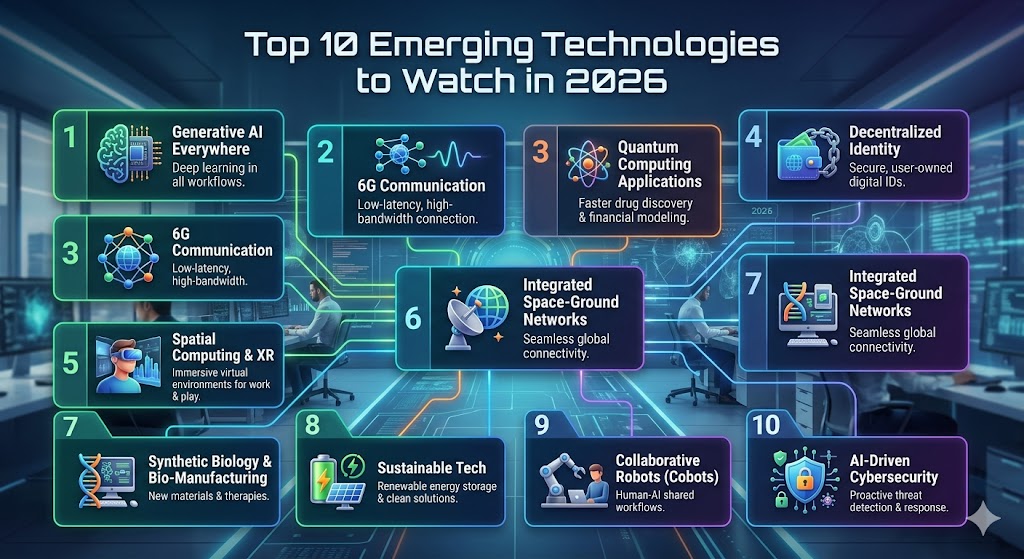
This article explores the top 10 emerging technologies to watch in 2026, including their impact, applications, benefits, challenges, and future potential.
1. Artificial Intelligence and Generative AI
The Rise of AI in 2026
Artificial Intelligence continues to dominate the technology landscape in 2026. AI systems are becoming more advanced, efficient, and integrated into nearly every industry.
AI technologies can:
- Analyze massive amounts of data
- Automate repetitive tasks
- Generate content
- Improve decision-making
- Predict outcomes
- Personalize experiences
- Enhance productivity
Generative AI has become one of the fastest-growing areas within artificial intelligence.
What Is Generative AI?
Generative AI refers to AI systems capable of creating:
- Text
- Images
- Videos
- Audio
- Software code
- Designs
- Simulations
These systems learn from existing data and generate original outputs.
Applications of AI in 2026
Healthcare
AI assists with diagnostics, medical imaging, and patient monitoring.
Finance
Banks use AI for fraud detection, risk analysis, and automated trading.
Education
AI-powered tutors personalize learning experiences.
Marketing
Businesses use AI for personalized advertising and customer insights.
Software Development
AI tools generate code and automate testing.
Benefits of AI
- Increased productivity
- Cost reduction
- Faster decision-making
- Personalized experiences
- Improved automation
Challenges
- Ethical concerns
- Data privacy issues
- Bias in algorithms
- Job displacement concerns
AI remains one of the most transformative technologies of the modern era.
Useful AI Resources:
2. Quantum Computing
What Is Quantum Computing?
Quantum computing uses quantum mechanics principles to process information far more efficiently than traditional computers.
Unlike classical computers that use bits, quantum computers use qubits, enabling complex calculations at incredible speeds.
Why Quantum Computing Matters
Quantum computers can solve problems that traditional computers struggle to process.
Industries Impacted by Quantum Computing
Healthcare
Accelerated drug discovery and genetic research.
Cybersecurity
Advanced encryption and security systems.
Finance
Complex financial modeling and risk analysis.
Logistics
Optimization of supply chains and transportation systems.
Benefits
- Faster processing power
- Advanced simulations
- Improved optimization
- Enhanced scientific research
Challenges
- High development costs
- Technical complexity
- Stability limitations
Quantum computing is expected to revolutionize scientific and industrial innovation over the next decade.
Useful Resource:
3. Extended Reality (XR)
Understanding XR Technology
Extended Reality includes:
- Virtual Reality (VR)
- Augmented Reality (AR)
- Mixed Reality (MR)
XR technologies blend physical and digital environments to create immersive experiences.
Applications of XR in 2026
Gaming
Immersive gaming experiences continue evolving rapidly.
Education
Virtual classrooms improve interactive learning.
Healthcare
Surgeons use AR for medical procedures and training.
Retail
Virtual try-ons improve online shopping experiences.
Real Estate
Virtual property tours enhance customer engagement.
Benefits
- Enhanced engagement
- Better visualization
- Improved training
- Interactive experiences
Challenges
- Hardware costs
- Motion sickness issues
- Privacy concerns
XR technology is becoming increasingly mainstream across industries.
Useful Resource:
4. 6G and Advanced Connectivity
Evolution Beyond 5G
While 5G is still expanding globally, researchers and companies are already developing 6G technology.
6G networks are expected to provide:
- Extremely fast internet speeds
- Ultra-low latency
- Improved connectivity
- Better support for smart devices
Applications of 6G
Smart Cities
Connected infrastructure improves urban management.
Autonomous Vehicles
Real-time communication enhances safety.
Healthcare
Remote surgeries and telemedicine improve healthcare access.
Industrial Automation
Factories become more intelligent and efficient.
Benefits
- Faster communication
- Better IoT performance
- Enhanced streaming experiences
- Improved remote operations
Challenges
- Infrastructure costs
- Regulatory issues
- Security concerns
Advanced connectivity technologies will shape the future of digital communication.
5. Internet of Things (IoT) and Smart Ecosystems
Growth of Connected Devices
The Internet of Things continues expanding rapidly in 2026.
IoT connects devices through the internet, allowing them to collect and exchange data.
Examples of IoT Devices
- Smart home systems
- Wearable fitness devices
- Connected vehicles
- Industrial sensors
- Smart appliances
Applications
Smart Homes
Automated lighting, security, and climate control systems.
Healthcare
Remote patient monitoring devices.
Agriculture
Smart farming systems improve crop management.
Manufacturing
Industrial IoT improves productivity and efficiency.
Benefits
- Automation
- Energy efficiency
- Real-time monitoring
- Improved convenience
Challenges
- Cybersecurity risks
- Data privacy concerns
- Device compatibility issues
IoT ecosystems are becoming smarter and more integrated every year.
6. Blockchain and Decentralized Technologies
Evolution of Blockchain
Blockchain technology is expanding beyond cryptocurrencies.
It provides secure, transparent, and decentralized digital systems.
Applications of Blockchain in 2026
Finance
Secure digital transactions and decentralized finance systems.
Supply Chain Management
Improved transparency and tracking.
Healthcare
Secure medical data sharing.
Digital Identity Verification
Enhanced authentication systems.
Benefits
- Improved transparency
- Better security
- Reduced fraud
- Decentralization
Challenges
- Scalability limitations
- Energy consumption concerns
- Regulatory uncertainty
Blockchain technology continues gaining adoption across industries.
Useful Resource:
7. Biotechnology and Genetic Engineering
Advances in Biotechnology
Biotechnology is transforming healthcare, agriculture, and environmental sustainability.
Key Innovations
Gene Editing
CRISPR technology enables precise genetic modifications.
Personalized Medicine
Treatments are tailored to individual genetic profiles.
Synthetic Biology
Scientists create engineered biological systems.
Lab-Grown Food
Alternative food production methods are expanding.
Benefits
- Improved healthcare
- Disease prevention
- Sustainable agriculture
- Enhanced food security
Challenges
- Ethical debates
- Regulatory concerns
- High research costs
Biotechnology is expected to play a major role in global health and sustainability.
8. Autonomous Systems and Robotics
Rise of Intelligent Automation
Robotics and autonomous systems are becoming more advanced in 2026.
AI-powered robots can perform tasks with minimal human intervention.
Applications
Manufacturing
Robots improve productivity and precision.
Logistics
Autonomous delivery systems optimize transportation.
Healthcare
Robotic surgery improves medical accuracy.
Agriculture
Automated farming equipment enhances efficiency.
Benefits
- Increased productivity
- Reduced labor costs
- Improved precision
- Enhanced safety
Challenges
- Workforce displacement concerns
- High implementation costs
- Ethical considerations
Automation technologies are transforming industries worldwide.
9. Green Technology and Sustainable Innovation
Importance of Sustainable Technologies
Climate change and environmental concerns are driving demand for green technologies.
Emerging Green Technologies
Renewable Energy Systems
Solar and wind technologies continue improving.
Electric Vehicles
EV adoption is growing globally.
Smart Energy Management
AI optimizes energy consumption.
Carbon Capture Technology
Systems reduce greenhouse gas emissions.
Benefits
- Environmental protection
- Energy efficiency
- Reduced emissions
- Sustainable development
Challenges
- Infrastructure costs
- Technology adoption barriers
Green innovation is becoming a major global priority.
Useful Resource:
10. Edge Computing
What Is Edge Computing?
Edge computing processes data closer to the source rather than relying entirely on centralized cloud servers.
Why Edge Computing Matters
Traditional cloud systems may experience latency issues for real-time applications.
Edge computing improves speed and efficiency.
Applications
Autonomous Vehicles
Real-time data processing improves safety.
Smart Cities
Connected infrastructure responds faster.
Healthcare Devices
Medical monitoring systems operate efficiently.
Industrial Automation
Factories process data instantly.
Benefits
- Lower latency
- Faster processing
- Reduced bandwidth usage
- Better reliability
Challenges
- Infrastructure complexity
- Security concerns
Edge computing is becoming essential for modern digital systems.
Impact of Emerging Technologies on Businesses
Digital Transformation
Businesses are rapidly adopting advanced technologies to remain competitive.
Benefits for Businesses
Improved Efficiency
Automation reduces operational workload.
Better Customer Experiences
AI and analytics personalize interactions.
Increased Innovation
New technologies create business opportunities.
Enhanced Decision-Making
Data-driven insights improve strategies.
Industries Experiencing Rapid Transformation
- Healthcare
- Finance
- Retail
- Education
- Manufacturing
- Transportation
- Entertainment
Companies investing in innovation are more likely to lead future markets.
Challenges of Emerging Technologies
Cybersecurity Risks
Advanced technologies create new security vulnerabilities.
Ethical Concerns
AI bias, privacy, and automation ethics remain important discussions.
High Costs
Adopting advanced technologies often requires significant investment.
Skills Gap
Businesses need skilled professionals to manage modern technologies.
Regulatory Challenges
Governments continue developing policies for emerging technologies.
Organizations must balance innovation with responsibility and compliance.
How Businesses Can Prepare for the Future
Invest in Research and Development
Innovation helps companies remain competitive.
Focus on Digital Skills
Workforce training is becoming increasingly important.
Adopt Scalable Technologies
Flexible systems support future growth.
Prioritize Cybersecurity
Security should remain a major focus.
Monitor Industry Trends
Staying informed helps businesses adapt quickly.
Strategic planning is essential for long-term technological success.
Future of Emerging Technologies Beyond 2026
The future of technology will likely include:
- More advanced AI systems
- Fully autonomous transportation
- Hyper-personalized digital experiences
- Advanced human-computer interfaces
- Smarter cities and infrastructure
- Sustainable technology ecosystems
- Faster global connectivity
- Immersive virtual environments
Innovation will continue accelerating across every major industry.
FAQs About Emerging Technologies in 2026
What are emerging technologies?
Emerging technologies are innovative advancements that are still developing but have the potential to significantly impact industries and society.
Why is AI considered one of the most important technologies?
AI improves automation, decision-making, personalization, and productivity across many industries.
What is the difference between VR and AR?
VR creates fully virtual environments, while AR adds digital elements to the real world.
Why is quantum computing important?
Quantum computing can solve highly complex problems much faster than traditional computers.
What industries benefit most from IoT?
Healthcare, manufacturing, agriculture, transportation, and smart home industries benefit heavily from IoT.
Is blockchain only used for cryptocurrency?
No. Blockchain is also used in supply chains, healthcare, identity verification, and finance.
What are the benefits of edge computing?
Edge computing reduces latency, improves speed, and enhances real-time data processing.
How are green technologies helping the environment?
Green technologies reduce emissions, improve energy efficiency, and support sustainable development.
Will automation replace human jobs?
Automation may replace some repetitive tasks, but it will also create new opportunities and industries.
Why should businesses follow technology trends?
Businesses that adopt emerging technologies early often gain competitive advantages and improve efficiency.
Conclusion
Emerging technologies are reshaping the world at an unprecedented pace. In 2026, innovations such as artificial intelligence, quantum computing, extended reality, advanced connectivity, IoT, blockchain, biotechnology, robotics, green technology, and edge computing are transforming industries and creating new opportunities for businesses and consumers alike.
These technologies are not only improving productivity and efficiency but also changing how people live, work, communicate, and interact with digital systems. Companies that embrace innovation and adapt to technological advancements will be better positioned for long-term success in an increasingly digital and competitive world.
At the same time, emerging technologies also introduce challenges related to ethics, cybersecurity, regulation, privacy, and workforce transformation. Organizations must approach innovation responsibly while preparing for continuous technological evolution.
The future beyond 2026 promises even greater advancements, making it essential for businesses, professionals, and individuals to stay informed, adaptable, and ready to embrace the next wave of digital transformation.