
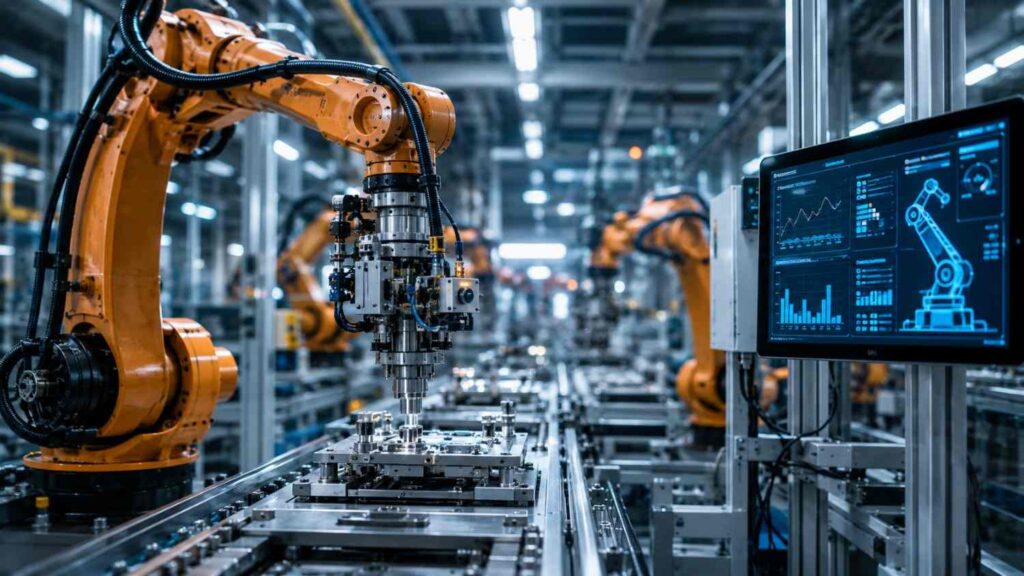
The Impact of Robotics on Manufacturing and Automation
Manufacturing has always evolved alongside technology, but robotics is changing industrial production at a particularly significant pace. Earlier automation systems were often designed around fixed machinery completing narrowly defined sequences with limited flexibility. Modern robotic systems can combine programmable motion, advanced sensors, machine vision, artificial intelligence, connected software, and real-time data. These capabilities allow manufacturers to automate a much wider range of production activities while adapting equipment more quickly when products or operating requirements change.
The scale of adoption illustrates why The Impact of Robotics on Manufacturing and Automation has become such an important business and technology issue. The International Federation of Robotics reported that approximately 542,000 industrial robots were installed worldwide in 2024. The global operational stock reached roughly 4.664 million units, demonstrating that robot adoption is no longer limited to a small number of highly automated automotive factories. Electronics, metalworking, logistics, consumer goods, pharmaceuticals, and other sectors increasingly use robotic systems to improve production performance.
However, installing robots does not automatically create a smart or efficient factory. Manufacturers still need stable processes, appropriate tooling, skilled employees, maintenance strategies, cybersecurity controls, safety procedures, and realistic return-on-investment expectations. Robotics creates the greatest value when it becomes part of a broader manufacturing strategy rather than a stand-alone equipment purchase. The real transformation lies in how companies combine machines, people, data, software, and process knowledge to build production systems that are more responsive, reliable, and competitive.
How Is Robotics Transforming Manufacturing Operations?
Robotics is transforming manufacturing operations by extending automation beyond the traditional high-volume production line. Industrial robots have long been used for repetitive tasks such as welding, material transfer, palletizing, machine loading, packaging, and assembly. These applications remain important because robots can execute programmed motions repeatedly with consistent speed and positioning. When a production process contains hundreds or thousands of identical movements, even modest improvements in cycle time and repeatability can produce meaningful operational gains.
The transformation becomes more significant when robots are connected to cameras, force sensors, programmable logic controllers, manufacturing execution systems, and real-time production data. A robot can now receive information about product type, part position, process conditions, or quality requirements before completing a task. This makes automation more responsive to variation and allows one robotic system to support several products or operations. NIST’s work on smart-manufacturing robotics emphasizes perception, mobility, dexterity, collaboration, and easier integration as important characteristics of modern robotic systems.
This greater flexibility is changing how manufacturers design production lines. Instead of building highly specialized automation that remains fixed for years, companies can increasingly deploy robots that are reprogrammable, equipped with interchangeable end effectors, or supported by machine vision. These capabilities are useful in environments where product life cycles are shorter and customer demand changes more frequently. As a result, robotics is becoming both a productivity tool and a way to make manufacturing systems more adaptable.
| Manufacturing Function | Robotics Application | Key Technology | Primary Operational Value | Related Entity/Concept |
|---|---|---|---|---|
| Assembly | Robotic assembly and component placement | Sensors, machine vision, programmable motion | Repeatability and production consistency | Smart manufacturing |
| Welding | Automated welding and joining | Industrial robots, sensors, automated controls | Consistent weld quality and cycle execution | Industrial robotics |
| Machine Tending | Loading and unloading CNC or production equipment | Robotic arms, grippers, sensors | Reduced repetitive handling and improved workflow | Factory automation |
| Quality Inspection | Automated visual inspection and defect detection | Machine vision, AI, cameras | Consistent quality monitoring and faster inspection | AI-powered robotics |
| Material Handling | Moving parts and materials between production areas | AMRs, robotic handling systems | Improved material flow and reduced manual movement | Autonomous mobile robots |
| Packaging | Automated packing, sorting, and palletizing | Robotic arms, vision systems | Higher consistency and scalable throughput | Manufacturing automation |
Robots Are Taking Over Repetitive and Precision Tasks
Repetitive work remains one of the clearest opportunities for industrial robotics. Tasks such as machine loading, component placement, spot welding, painting, packing, palletizing, and product transfer often require workers to repeat similar physical movements throughout an entire shift. Robots can perform these sequences consistently while reducing the amount of time employees spend on monotonous or ergonomically demanding activities.
Precision is another major advantage. Robotic systems can maintain repeatable positioning across large production volumes, making them valuable for assembly, machining support, electronics manufacturing, and automated inspection. When combined with cameras, force sensors, or machine vision, robots can also identify component orientation, confirm positioning, detect visible defects, or adapt a movement when a part is not located exactly where expected.
However, repetitive work should not be automated simply because it can be. Manufacturers still need to evaluate cycle time, equipment utilization, product variation, tooling, maintenance, safety, and production constraints. A successful robotics project improves the entire process rather than replacing a human motion with an expensive machine that creates new bottlenecks elsewhere in the production line.
Collaborative and Flexible Automation Is Expanding
Traditional industrial robots have typically operated inside guarded cells, separated from workers by fences, gates, scanners, or other safety systems. Collaborative robots, commonly called cobots, have expanded the range of possible automation applications by supporting appropriately designed tasks where people and robots can operate more closely. IFR reported that cobots represented more than 10% of industrial robot installations worldwide in 2023.
Their appeal comes largely from flexibility. Cobots can be used for machine tending, light assembly, inspection, packaging, laboratory work, and other applications where manufacturers want automation without building a large permanent robotic cell. A collaborative robot can sometimes be moved between workstations or reprogrammed for different processes, making this technology attractive to manufacturers producing smaller batches or changing product mixes.
Nevertheless, the word “collaborative” should never be interpreted as automatically safe. The complete application must be assessed, including robot speed, payload, tooling, sharp components, surrounding machines, workpiece hazards, and possible human contact. Proper risk assessment and engineering controls remain essential even when the robot itself includes collaborative safety functions.
Related Articles
What Are the Main Benefits of Robotics in Manufacturing?
The strongest business case for robotics normally comes from several improvements occurring together rather than from one isolated benefit. A robot may increase production speed, but it can also reduce cycle-time variation, improve quality consistency, limit ergonomic strain, increase equipment utilization, and make production performance easier to measure. When these benefits reinforce each other, automation can change the economics of an entire manufacturing process rather than simply reducing the manual effort associated with one task.
Robot adoption is already extensive enough to influence regional manufacturing competitiveness. International Federation of Robotics data published for 2026 shows that Western Europe had approximately 267 industrial robots per 10,000 manufacturing employees in 2024. North America had around 204, while Asia had approximately 131. Robot density alone does not determine productivity, but these figures demonstrate the significant role industrial automation now plays in advanced manufacturing systems.
Research on robotics in manufacturing also highlights improved production efficiency, consistency, and worker safety as key benefits of integrating robotic systems.
The benefits still depend heavily on implementation quality. A robotic system cannot fully compensate for unreliable incoming materials, inconsistent product design, weak maintenance practices, poor fixtures, or badly organized production flow. Manufacturers achieve stronger results when robotics is introduced alongside process improvement, workforce development, preventive maintenance, and performance measurement. Automation should therefore be evaluated as part of a complete production system, not only as a piece of equipment.
| Manufacturing Area | Potential Robotics Impact | Typical Application |
|---|---|---|
| Productivity | More consistent cycle execution | Assembly, welding, machine tending |
| Quality | Greater repeatability and automated inspection | Vision inspection, precision placement |
| Safety | Reduces human exposure to hazardous work | Welding, heavy handling, dangerous environments |
| Flexibility | Reprogrammable equipment for product changes | Cobots, flexible assembly |
| Material Flow | Automated movement across production areas | AMRs, robotic handling |
| Labor Utilization | Frees skilled workers from repetitive work | Loading, packing, repetitive handling |
Productivity, Quality, and Consistency Can Improve
Robotic automation can improve productivity by executing repetitive production cycles with consistent timing and reduced variation. In processes where machines wait for manual loading, unloading, or handling, automation may increase equipment utilization and reduce idle periods. Robots can also support extended operating schedules when appropriate maintenance, supervision, and material supply systems are available.
Quality improvements often come from repeatability combined with better inspection. Robots can place, weld, assemble, dispense, or handle components using tightly controlled programmed movements. When cameras and other sensors are added, robotic systems can help inspect products for positioning errors, missing components, surface problems, dimensional variation, or other visible quality issues.
Manufacturers should still remember that faster production is useful only when the process remains stable. If incoming parts vary or equipment frequently fails, a faster robot may simply create defects more quickly. Strong automation projects therefore track throughput, first-pass yield, scrap, downtime, rework, and cycle time together rather than evaluating productivity in isolation.
Robotics Can Support Safety and Labor Availability
Robots can reduce human exposure to tasks involving heavy lifting, repetitive motion, heat, fumes, chemicals, moving machinery, or difficult ergonomic positions. Welding, foundry work, machine loading, material handling, palletizing, and other applications can sometimes be redesigned so robots perform the physically demanding portion while employees supervise, inspect, or maintain the process.
Labor availability is another important factor. IFR identifies workforce shortages as one of the global trends supporting robotics adoption in 2026. Manufacturers in many regions struggle to recruit employees for repetitive, physically demanding, or highly specialized production roles. Robotics can help companies maintain capacity when specific positions are difficult to fill.
Automation does not eliminate the need for people. Instead, it changes the type of work required. Technicians, operators, engineers, maintenance specialists, programmers, quality professionals, and production supervisors remain critical. Strong implementations use robotics to reduce undesirable work while giving employees opportunities to move toward higher-value responsibilities requiring judgment, problem solving, technical knowledge, and process understanding.
How Are AI and Smart Automation Changing Industrial Robots?
Artificial intelligence is extending industrial robotics beyond highly predictable motion. Traditional robots normally perform operations based on programmed coordinates and deterministic logic. Modern systems can increasingly combine robotics with machine vision, AI models, connected sensors, data analytics, and production software. These technologies allow automated systems to interpret changing conditions and make limited adjustments instead of requiring every possible variation to be manually programmed.
The International Federation of Robotics identifies AI and autonomy as a major robotics trend for 2026. IFR also highlights IT/OT convergence, safety and cybersecurity, humanoid development, and labor shortages as important forces influencing the industry. These trends indicate that the future of factory automation will involve more than improvements in mechanical robot arms. Manufacturers will increasingly rely on software, data, sensing, and connected digital infrastructure to expand what robotic systems can accomplish.
NIST’s manufacturing work also highlights applications such as smart assembly, AI-supported collaborative robotics, autonomous material handling, and intelligent inspection. The result is a factory environment where robots can increasingly participate in connected workflows rather than operating as isolated islands of automation. This creates new opportunities for efficiency and flexibility, but it also increases the need for reliable data, system validation, cybersecurity, and technical skills.
AI, Computer Vision, and Autonomous Decision Support
Machine vision gives robotic systems a way to interpret visual information rather than depending entirely on fixed coordinates. Cameras and perception software can identify components, determine orientation, locate objects, check assemblies, and support automated inspection. This is particularly valuable when parts arrive in slightly different positions or when the system must identify several product variations.
Artificial intelligence can extend these capabilities by helping software recognize patterns and manage greater variability. NIST has described AI applications in manufacturing that include smart assembly, computer-vision-supported navigation, and adaptive robotic processes. These technologies can make automation more flexible when production conditions are not identical from one cycle to the next.
Manufacturers should still distinguish AI-supported decision making from unrestricted autonomy. Industrial production requires repeatability, reliability, safety, and validation. Any AI-enabled robotic system needs defined operating limits and appropriate human oversight. Trustworthy deployment means understanding where the system performs reliably, monitoring its outputs, and ensuring unexpected conditions do not create unsafe or unacceptable production outcomes.
IT/OT Integration Is Creating Smarter Factory Systems
Operational technology controls physical manufacturing equipment, while information technology manages software, networks, business systems, and data. Historically, these environments were often separated. Smart manufacturing increasingly connects them so robots, sensors, production systems, enterprise software, and analytical platforms can exchange information more effectively.
IFR identifies IT/OT convergence as an important robotics trend because connected data can make automation more responsive. Robots can receive production schedules, report operating conditions, support traceability, and provide information for maintenance or quality analysis. Integration with manufacturing execution systems can also help production teams coordinate work across several automated processes.
Greater connectivity creates additional responsibilities. A robot connected to a factory network becomes part of the organization’s digital infrastructure rather than simply a mechanical device. Manufacturers therefore need to consider access control, software updates, network segmentation, data governance, cybersecurity monitoring, and recovery procedures. Smart factories gain value from connectivity only when that connectivity is managed reliably and securely.
What Are the Workforce and Job Impacts of Manufacturing Robotics?
The workforce effects of robotics are more complicated than the idea that machines simply eliminate manufacturing jobs. Robots can replace specific tasks, particularly activities that are repetitive, physically demanding, highly predictable, or dangerous. However, automation can also create new technical responsibilities involving robot programming, controls, maintenance, integration, troubleshooting, production supervision, data analysis, and quality management. The overall effect depends on the industry, type of automation, labor market, and workforce strategy.
This broader workforce transformation can create new roles in robot maintenance, programming, systems management, and other technical areas as routine tasks become automated.
The World Economic Forum’s Future of Jobs Report 2025 found that 58% of surveyed employers expected robots and autonomous systems to transform their organizations by 2030. That does not mean 58% of jobs will disappear. Rather, it indicates that the way work is organized is likely to change as automated systems assume a larger share of routine production activities.
Manufacturers therefore need to analyze work at the task level. A machine operator may perform less repetitive loading after automation but spend more time monitoring several machines, responding to alarms, inspecting quality, changing tooling, or coordinating production. Companies that plan for these changes can use robotics to improve both productivity and job quality, while companies that ignore workforce development may struggle to capture the full value of their investment.
Automation Changes Jobs as Well as Tasks
Robotics is particularly effective at repetitive, predictable, and physically strenuous tasks. When these activities are automated, employees can move toward responsibilities involving judgment, supervision, troubleshooting, maintenance, or process improvement. This does not mean every displaced task automatically becomes a higher-skilled job, but it does show why the labor impact of robotics needs to be analyzed more carefully than simple headcount reduction.
Manufacturers still need people who understand automated production equipment. The U.S. Bureau of Labor Statistics describes electro-mechanical and mechatronics technicians as workers who install, operate, test, maintain, and repair automated and robotic equipment. Similar technical roles exist across controls engineering, industrial maintenance, programming, and systems integration.
Effective workforce planning begins before installation. Employers should identify which tasks will change, which roles will require new skills, and which workers can be trained for those responsibilities. Employees are more likely to support automation when they understand how their jobs will evolve and see practical opportunities to participate in the new production system.
Reskilling Becomes a Core Automation Requirement
Highly automated factories still depend on human expertise. Operators may need to understand robot interfaces, fault recovery, safety procedures, sensors, machine vision, and automated production logic. Maintenance employees may need deeper knowledge of electrical systems, PLCs, networks, robotics, preventive maintenance, and data-driven troubleshooting.
Workforce initiatives increasingly recognize this requirement. Manufacturing.gov highlights organizations such as the Advanced Robotics for Manufacturing Institute, which works not only on robotics technology but also on preparing employees to work alongside advanced manufacturing systems. Training is therefore becoming part of the infrastructure required for successful automation.
I recommend treating reskilling as a direct component of the robotics investment rather than as a separate human-resources activity. A technically sophisticated system will not deliver its expected return if employees cannot operate it effectively, recover from faults, maintain tooling, or interpret performance data. Investing in people and equipment simultaneously creates a more resilient automation strategy.
What Challenges Should Manufacturers Consider Before Automating?
Robotics can generate significant value, but implementation is more complex than purchasing a robot and positioning it beside an existing production line. A functioning system may require custom end-of-arm tooling, fixtures, guarding, vision systems, safety scanners, conveyors, electrical infrastructure, controllers, software, network connections, employee training, spare parts, and maintenance procedures. These surrounding requirements can represent a substantial portion of the total project effort and cost.
Manufacturers also need to determine whether the production process is stable enough to automate. NIST has highlighted challenges involving robot performance measurement, integration, usability, and confidence that systems will function reliably in real manufacturing environments. Small and medium-sized manufacturers may face additional difficulties because they often have fewer internal robotics engineers or automation specialists available.
The strongest projects therefore begin with a clearly defined operational problem. The objective should not be to maximize the number of robots in the factory. Automation makes sense when it addresses specific constraints such as repetitive labor, quality variation, machine utilization, safety exposure, production bottlenecks, or workforce shortages. Technical feasibility, operational readiness, safety, and financial return should all be evaluated together before implementation begins.
| Adoption Consideration | What Manufacturers Evaluate | Relevant Robotics Factor | Business Impact | Supporting Concept |
|---|---|---|---|---|
| Process Suitability | Cycle time, task repetition, product variation | Robot capability and flexibility | Determines automation feasibility | Robotic automation |
| Integration | Tooling, sensors, controls, software, equipment | Robot integration | Influences implementation complexity | Smart manufacturing |
| Safety | Hazards, guarding, human interaction, risk assessment | Robot safety systems | Protects workers and supports compliance | ISO 10218, OSHA |
| Workforce Skills | Programming, maintenance, controls, troubleshooting | Workforce reskilling | Supports reliable long-term operation | Human-robot collaboration |
| ROI | Throughput, labor utilization, scrap, downtime, maintenance | Automation investment | Determines financial viability | Automation ROI |
| Cybersecurity | Network access, software, connected equipment | IT/OT integration | Reduces digital and operational risks | Industrial cybersecurity |
| Scalability | Future products, production changes, additional automation | Flexible robotics | Supports long-term manufacturing growth | Industry 4.0 |
Integration Cost, Reliability, and ROI Need Careful Planning
The cost of a robotics project extends well beyond the robot arm. Engineering, end effectors, guarding, conveyors, machine vision, electrical work, controls, programming, commissioning, employee training, maintenance, and spare parts can significantly affect the total investment. Future product changes may also require additional programming or tooling.
A strong business case should compare the current process with the proposed automated process using measurable indicators. Relevant factors can include throughput, labor utilization, scrap, rework, quality, downtime, maintenance, floor space, safety, energy use, and expected equipment life. Manufacturers should also account for installation downtime and the learning period required before a new system reaches stable production.
One thing I always recommend is automating a process that is already reasonably understood. If inputs are unstable, work instructions are unclear, or product designs change constantly, robotics can magnify those problems rather than solve them. Process improvement and automation planning should therefore happen together.
Safety, Standards, and Cybersecurity Cannot Be Optional
Industrial robot safety requires structured risk assessment rather than assumptions based on robot type. In the United States, OSHA provides robotics guidance and references for identifying and controlling hazards even though there is no single OSHA standard devoted exclusively to robots. Applicable machine-safety, electrical, lockout, and workplace requirements can still apply to robotic installations.
International standards provide additional guidance. ISO 10218-1:2025 addresses safety requirements for industrial robots, while ISO 10218-2:2025 addresses industrial robot applications and robot cells. These standards are important references for robot manufacturers, system integrators, and manufacturing users designing or operating automated systems.
Cybersecurity must also be considered because modern robots increasingly connect to networks, cloud platforms, enterprise software, and AI tools. Physical safety and digital security are becoming interconnected. Manufacturers should address access permissions, software maintenance, network segmentation, remote connections, data protection, backup procedures, and incident response as part of robotic-system governance.
Quick Answer About The Impact of Robotics on Manufacturing and Automation
The Impact of Robotics on Manufacturing and Automation can be seen in higher production consistency, faster cycle times, better quality control, safer handling of hazardous tasks, and increased flexibility across modern factories. Industrial robots are widely used for welding, assembly, machine tending, palletizing, packaging, inspection, and material movement. Newer systems also combine robotics with artificial intelligence, machine vision, sensors, digital twins, and connected manufacturing software.
Robotics is becoming more important because manufacturers must increase output while controlling costs, responding to labor shortages, and producing a wider variety of products. According to the International Federation of Robotics, 542,000 industrial robots were installed worldwide in 2024, while the global operational stock reached approximately 4.664 million units. That scale demonstrates how deeply industrial robotics has become embedded in global manufacturing.
The most important change is that robots are no longer viewed only as isolated machines performing one repetitive operation. They are increasingly integrated into wider smart-manufacturing environments where production equipment, data systems, employees, and software work together. As robotics becomes more intelligent and connected, manufacturers must balance productivity gains with integration costs, workforce development, cybersecurity, maintenance, and safety.
Frequently Asked Questions About The Impact of Robotics on Manufacturing and Automation
Questions about The Impact of Robotics on Manufacturing and Automation usually focus on productivity, employment, artificial intelligence, safety, and cost. These are reasonable concerns because robotics affects both the physical production process and the people responsible for operating it. A successful automation strategy therefore requires understanding more than the mechanical capabilities of a robot.
The answers below provide a practical introduction to the most common questions manufacturers, students, engineers, and business leaders ask about industrial robotics. They are designed to explain both the benefits and limitations of automation rather than presenting robotics as a universal solution for every manufacturing problem.
Individual factories can experience very different outcomes depending on product design, volume, workforce availability, existing equipment, technical skills, safety requirements, and capital resources. Manufacturers should therefore use these answers as a starting point and conduct detailed technical, financial, and safety assessments before committing to major automation investments.
How Are Robots Changing Manufacturing?
Robots are changing manufacturing by automating repetitive production, assembly, welding, machine tending, inspection, packaging, and material-handling tasks. Their ability to execute programmed operations consistently can help manufacturers reduce variation and make production performance more predictable.
Modern robots are also becoming more flexible. Machine vision, sensors, artificial intelligence, and connected manufacturing software can allow robotic systems to respond to different parts, production conditions, or work orders. Autonomous mobile robots can also move materials between production areas without relying entirely on fixed conveyors.
The larger change is therefore not simply replacing manual work. Robotics is becoming part of an integrated manufacturing system that combines people, automated machinery, digital data, and production software. This enables factories to pursue higher productivity while also increasing flexibility and process visibility.
What Are the Biggest Benefits of Robotics in Manufacturing?
The main benefits of robotics can include improved repeatability, higher potential throughput, more consistent quality, reduced exposure to dangerous work, and better use of skilled employees. Robots are particularly valuable for processes where the same movement must be repeated many times with limited variation.
Automation can also improve production data. Modern robotic systems can report cycle times, fault conditions, operating states, or process information, helping manufacturers identify bottlenecks and improve maintenance. When integrated with inspection systems, robots can support more consistent quality checks.
However, benefits vary considerably between applications. Poorly designed automation can create downtime, maintenance problems, or unnecessary complexity. Manufacturers should evaluate the complete process and determine whether robotics solves an operational problem that is meaningful enough to justify the required investment.
Will Robots Replace Manufacturing Workers?
Robots can replace specific manual tasks, especially work that is repetitive, highly predictable, hazardous, or physically demanding. Some occupations may therefore require fewer employees when a large percentage of their existing tasks become automated.
At the same time, robotics creates demand for new responsibilities involving programming, maintenance, controls, integration, quality, troubleshooting, data analysis, and production supervision. The U.S. Bureau of Labor Statistics recognizes technical occupations responsible for operating, testing, maintaining, and repairing robotic and automated equipment.
The most realistic outcome is job transformation rather than a single universal result. Workforce impact varies by industry, company, region, and task. Manufacturers that invest in training and reskilling can often redeploy experienced employees into technical or supervisory roles that support the automated production environment.
What Is the Difference Between Robotics and Automation?
Automation is the broader concept of using technology to perform processes with reduced direct human intervention. It can include software, conveyors, programmable logic controllers, automated inspection, CNC equipment, process control, and many other technologies that may not involve a robot.
Robotics is a specific branch of automation involving programmable physical machines that can move, manipulate objects, interact with equipment, or perform manufacturing tasks. An industrial robot arm used for welding or palletizing is therefore one type of automated system.
A factory can be highly automated without containing many robots. Conversely, a factory may use several robots while still depending heavily on manual processes elsewhere. Understanding the difference helps manufacturers select the technology that best solves each production problem instead of assuming every automation opportunity requires a robot.
How Is AI Used in Manufacturing Robots?
Artificial intelligence can support industrial robotics through computer vision, pattern recognition, object identification, path planning, anomaly detection, smart assembly, and adaptive process control. These capabilities are useful when a robot needs to deal with more variation than traditional fixed programming can easily manage.
AI-enabled vision may help a system identify parts arriving in different orientations, while intelligent planning can help autonomous mobile robots navigate changing factory environments. AI may also support predictive maintenance by helping identify patterns that suggest equipment problems are developing.
These applications still require careful validation. Manufacturing environments demand reliable and predictable operation. AI should therefore be deployed with clear operating limits, appropriate monitoring, reliable data, and human oversight. The goal is controlled adaptability rather than uncontrolled decision-making.
Are Collaborative Robots Safe to Work Beside People?
Collaborative robots are designed with features that can support applications involving closer human interaction, but their use does not automatically make a workstation safe. The entire application must be evaluated, including speed, force, payload, tooling, sharp workpieces, pinch points, and surrounding equipment.
A cobot carrying a lightweight rounded component may present very different risks from the same robot handling a sharp metal part or operating beside a dangerous machine. Safety therefore depends on the task and system design rather than on the robot label alone.
Manufacturers should perform formal risk assessments and follow applicable safety standards such as ISO 10218. Depending on the application, additional guarding, scanners, reduced speeds, safe zones, emergency stops, or other controls may still be necessary to protect employees.
Conclusion
The Impact of Robotics on Manufacturing and Automation extends far beyond the replacement of manual movement with machines. Robotics is reshaping productivity, quality, production flexibility, material flow, workforce planning, safety, maintenance, and digital manufacturing. With millions of industrial robots already operating globally, automation has become an important element of industrial competitiveness rather than a technology limited to a few highly automated sectors.
The next stage of development will increasingly involve intelligence and connectivity. Artificial intelligence, machine vision, autonomous navigation, IT/OT convergence, collaborative robots, and advanced sensing are expanding what robotic systems can accomplish. At the same time, these capabilities create new responsibilities involving cybersecurity, data management, technical skills, standards, and system validation. Manufacturers will need to improve both their technology infrastructure and their organizational capabilities.
The companies that benefit most will not necessarily be those with the highest number of robots. Competitive advantage will come from selecting the right processes, integrating automation carefully, training employees, maintaining equipment effectively, and measuring whether robotics delivers genuine operational improvement. When technology, people, and process design are aligned, robotics can become a long-term manufacturing capability rather than simply a capital-equipment purchase.
The Main Takeaway
Robotics creates the most value when it addresses a clearly defined manufacturing problem. That problem may involve inconsistent cycle times, dangerous work, repetitive handling, quality variation, labor shortages, material movement, or the need for faster product changeovers.
Manufacturers should therefore begin with the process rather than the robot. Measure current performance, identify bottlenecks, understand production variation, and determine whether automation can improve the overall system. This reduces the risk of investing in equipment that solves the wrong problem.
The future factory will likely combine people, robots, AI, sensors, software, and conventional automation rather than depend entirely on either humans or machines. Effective human-robot collaboration will therefore remain central to successful manufacturing transformation.
What Manufacturers Should Do Next
Begin by identifying a small number of processes where automation could address measurable operational problems. Record current cycle times, staffing requirements, scrap, rework, downtime, ergonomic risks, and production variability before discussing specific robotic technologies.
Next, conduct a complete feasibility assessment covering tooling, integration, production changeovers, safety, maintenance, cybersecurity, workforce skills, floor space, and return on investment. The robot purchase price should never be the only financial consideration because supporting equipment and engineering can represent a substantial portion of total project cost.
Finally, invest in internal capability as automation expands. Operators, technicians, engineers, maintenance teams, and supervisors should understand how robotic systems work and how to respond when performance changes. Combining technology investment with workforce development gives manufacturers a stronger foundation for sustainable automation.