
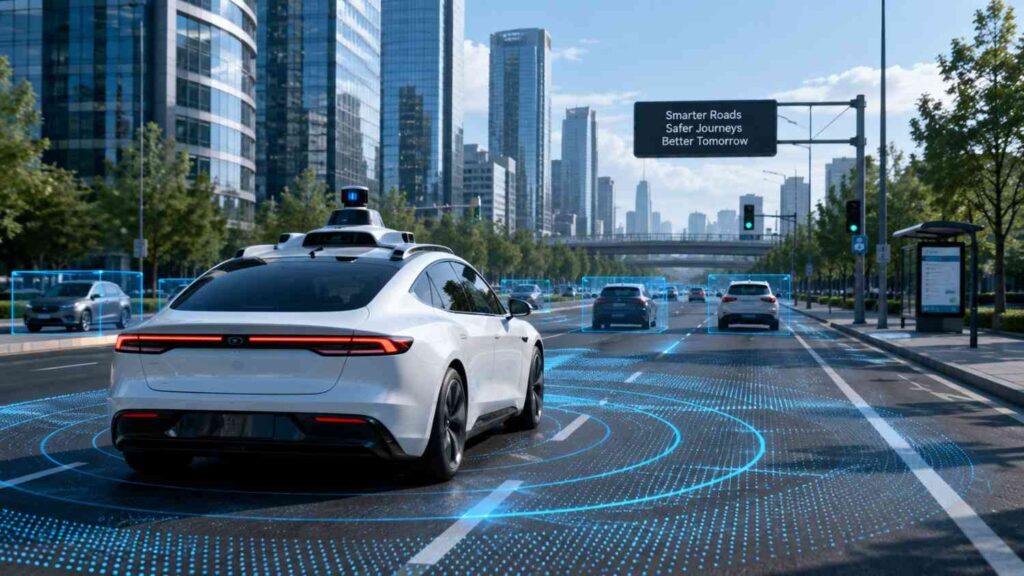
How Autonomous Vehicles Are Changing Transportation
How Autonomous Vehicles Are Changing Transportation can be understood most clearly by looking at where the technology is already being used. Autonomous systems are entering passenger travel through robotaxis, freight movement through corridor-based trucking, public transportation through research and demonstration programmes, and personal vehicles through advanced driver-assistance features.
The transition is gradual because “automation” describes several different levels of capability. NHTSA uses a six-level structure ranging from Level 0, where the human performs the driving task, to Level 5, where an automated system can perform the complete driving task under all road and environmental conditions that a competent human could manage.
| Automation Level | Main Capability | Human Role | Typical Status |
|---|---|---|---|
| Level 0 | Warnings or momentary assistance | Fully responsible | Widely available |
| Level 1 | Steering or speed assistance | Continuously supervises | Widely available |
| Level 2 | Steering and speed assistance together | Continuously supervises | Available in many vehicles |
| Level 3 | System drives under limited conditions | Must respond when requested | Limited deployment |
| Level 4 | System drives within a defined domain | No driver needed inside that domain | Selected commercial services |
| Level 5 | System drives under all relevant conditions | No driver required | Not broadly deployed |
A Level 2 highway-assistance feature, a Level 4 robotaxi, and a driverless freight truck are therefore different products with different operating limits and human responsibilities. Treating them as interchangeable creates confusion about safety and capability.
One thing I always separate is the technical driving level from the product name. A confident-sounding brand label does not determine whether the user must watch the road or remain ready to intervene. The operating instructions and documented capability matter more.
Autonomous transportation also requires organisational systems around the vehicle. Fleet operators need maintenance, mapping, remote support, customer service, cleaning, charging, incident response, cybersecurity, regulatory compliance, and emergency-service coordination.
The result is a transformation of the entire mobility system rather than a simple replacement of drivers with software. The following sections explain how that transformation affects technology, passenger travel, freight, transit, safety, infrastructure, employment, regulation, and public trust.
Understanding the Technology and Its Current Limits
Autonomous vehicle technology combines physical sensors, vehicle controls, high-performance computing, artificial intelligence, mapping, positioning, and operational support. The system must perceive the road environment, understand which objects matter, predict how people and vehicles may move, plan a safe route, and control the vehicle continuously.
This task is difficult because public roads are open and highly variable environments. Construction zones change lane layouts. Pedestrians behave unpredictably. Emergency personnel may direct traffic using gestures. Weather can obscure markings and sensors. An unusual object may not resemble anything expected by the system.
The practical capability of an autonomous vehicle is therefore defined not only by its software but also by where, when, and under which conditions it is designed to operate. A system that performs reliably on mapped urban streets in clear weather may not be suitable for rural roads, heavy snow, flooding, or unmapped construction.
Autonomous fleets also depend on operational systems outside the vehicle. They may use remote-assistance teams, continuously updated maps, fleet-monitoring centres, maintenance facilities, and carefully designed procedures for unusual situations.
This wider operating structure explains why commercial deployment usually begins in limited areas. Restricting the operational design domain allows the developer to define and test a manageable set of roads and conditions before expanding.
For beginners, the essential point is that autonomy is not a single intelligence that can automatically handle every road. It is an engineered transportation service with documented boundaries.
For advanced readers, those boundaries become central to safety assurance, validation, fallback behaviour, regulatory approval, and the design of scalable fleet operations.
Sensors, Software, and the Operational Design Domain
Autonomous vehicles may use cameras, radar, lidar, microphones, satellite positioning, inertial sensors, wheel-speed data, and detailed maps. Each sensing method provides different information and has different limitations.
Cameras can recognise signals, signs, colours, and visual features. Radar measures distance and relative speed effectively in many conditions. Lidar creates detailed three-dimensional measurements of nearby objects. Positioning and inertial systems help estimate where the vehicle is located and how it is moving.
Software combines these inputs to identify lanes, vehicles, pedestrians, cyclists, signals, obstacles, and open driving space. It then predicts likely movement and chooses a path that follows traffic rules while maintaining suitable distances.
The operational design domain defines the conditions in which this complete system is intended to work. It may include specific roads, mapped areas, speeds, weather, lighting, and traffic conditions.
A Level 4 system can operate without a human driver within that domain, but it must recognise when conditions fall outside its capability. It then needs an appropriate fallback, such as stopping safely or reaching a designated location.
This concept prevents misleading all-or-nothing thinking. A vehicle may perform highly automated driving successfully within a well-defined service area without being capable of unrestricted nationwide operation.
Remote Assistance Does Not Always Mean Remote Driving
Commercial autonomous fleets may use remote-assistance teams when vehicles encounter unusual or ambiguous situations. A vehicle might request additional context about a temporary road closure, construction worker, blocked lane, or unexpected routing problem.
Remote assistance is not necessarily the same as continuous remote driving. Waymo describes its remote-assistance model as providing contextual advice rather than directly controlling the vehicle. The automated driving system remains responsible for evaluating that information and selecting the driving action.
This distinction matters for communications reliability and safety. A system that depends on constant remote steering would face different latency, connectivity, licensing, and human-performance risks from a system that occasionally requests high-level guidance.
Remote operations still create new transportation roles. Fleets require personnel who understand mapping, unusual road events, customer needs, incident response, and communication with public authorities. Operators also need clear escalation procedures when a vehicle cannot continue safely.
The remote-support model must define what information personnel can provide, what they cannot command, how decisions are recorded, and what happens if communications fail.
For passengers and regulators, transparency about remote involvement is important. People should understand whether the vehicle is operating independently, receiving advice, or being actively controlled from another location.
Driver Assistance Is Not Full Autonomy
Most automation available in privately owned vehicles remains advanced driver assistance rather than fully autonomous driving. These systems may maintain speed, follow another vehicle, centre the car in a lane, brake for hazards, or assist with selected manoeuvres.
At Level 2, steering and acceleration or braking can operate together, but the human driver remains responsible for supervising the road and system. NHTSA’s consumer guidance emphasises that the driver must remain engaged and ready to take control.
Confusing assistance with autonomy creates a serious human-factors problem. A driver who overestimates the technology may look away, become distracted, or respond too slowly when the system reaches a situation it cannot manage.
The solution requires more than a warning in the owner’s manual. Vehicles need clear interface language, driver-monitoring systems, understandable alerts, suitable escalation, and marketing that accurately describes responsibility.
Drivers should know which roads and conditions are supported, how the system communicates uncertainty, and what happens when attention is not detected.
For transportation planners and policymakers, supervised automation should also be evaluated separately from driverless fleets. The crash risks, user behaviour, liability questions, and operational controls differ significantly.
The simplest rule is that a driver-assistance feature supports the person at the wheel; it does not automatically replace that person.
Related Articles
Passenger Travel, Freight, and Public Transit Are Evolving
Autonomy is entering transportation through several business models rather than one universal vehicle. Robotaxis automate selected ride-hailing journeys, autonomous trucks target repeatable freight routes, and transit organisations are researching automated shuttles, buses, yards, and microtransit services.
Each mode presents different technical and operational challenges. Passenger services must handle pickups, drop-offs, rider communication, lost property, accessibility, cleaning, and dense interaction with pedestrians and cyclists. Freight operations focus more heavily on highway reliability, terminals, vehicle utilisation, inspections, maintenance, and supply-chain timing.
Public transit introduces another set of priorities. Transit agencies must serve diverse passengers, maintain equitable access, integrate with existing routes, and comply with accessibility obligations. Automation may be used first in bus yards or controlled shuttle routes before expanding into complex mixed traffic.
These deployments can also reshape transportation networks. Robotaxis may alter parking demand and ride-hailing competition. Autonomous trucking may influence warehouse locations and freight schedules. Automated transit could support first- and last-mile links that are currently expensive to provide with conventional fixed-route service.
However, automation does not remove the need for people. Commercial fleets still depend on customer support, maintenance, roadside response, dispatch, mapping, charging, cleaning, safety management, and regulatory compliance.
The most realistic near-term model is therefore a reorganisation of transportation work rather than the immediate elimination of human involvement.
To evaluate the effect of autonomy, decision-makers should examine the complete service. A driverless vehicle may appear efficient on the road while still requiring expensive support behind the scenes.
| Transportation Sector | How Autonomous Vehicles Are Used | Primary Benefits | Current Challenges |
|---|---|---|---|
| Passenger Ride-Hailing | Robotaxis provide driverless trips within approved service areas | Greater mobility, consistent service, reduced operating costs | Geofenced operation, regulatory approvals, rider trust |
| Freight & Logistics | Autonomous trucks transport goods on predefined highway corridors | Improved fleet efficiency, predictable delivery schedules | Weather limitations, terminal coordination, regulations |
| Public Transit | Automated shuttles and buses serve campuses, healthcare, and urban routes | Better accessibility, first- and last-mile connectivity | Infrastructure upgrades, inclusive design requirements |
| Delivery Services | Driverless delivery vehicles transport parcels and small goods | Faster deliveries, reduced labor requirements | Sidewalk safety, local regulations, operational limitations |
Robotaxis Are Creating a New Form of Ride-Hailing
Robotaxis allow passengers to request transportation in a vehicle without a human driver inside it. The service combines automated driving with fleet dispatch, route planning, rider support, vehicle maintenance, charging, cleaning, and regulatory permission.
Waymo’s current website lists autonomous rider service across multiple U.S. metropolitan areas, showing that robotaxis have moved beyond research demonstrations into commercial transportation. Availability and access differ by city, and some markets involve ride-hailing partnerships rather than only the operator’s own application.
The immediate effect is not the disappearance of private cars or human-driven taxis. Robotaxis add another option to the mobility market, especially in dense areas where fleets can serve many trips within a defined operating domain.
Potential benefits include consistent service procedures, automated dispatch, private passenger space, and mobility for people who cannot or prefer not to drive. The actual value depends on service coverage, waiting time, price, accessibility, and reliability.
Robotaxis can also create new urban-management challenges. Vehicles need safe pickup locations, places to wait, charging facilities, and rules that prevent unnecessary circulation or curb blockage.
Cities should therefore evaluate robotaxis as transportation systems rather than isolated vehicles. The relevant outcomes include trip volume, empty mileage, transit interaction, accessibility, congestion, safety, and service distribution across communities.
Autonomous Trucking Is Reshaping Freight Networks
Autonomous trucking is developing first on structured freight corridors where roads, routes, terminals, and operating conditions can be managed more predictably than complex local delivery environments.
Aurora began commercial driverless freight operations in Texas in 2025 and expanded its Dallas–Houston service to nighttime operation later that year. Aurora’s filings state that its initial deployment focuses on Texas freight corridors and that expansion decisions depend on commercial, technical, and regulatory factors. These are company-reported developments and should be interpreted alongside independent regulatory oversight.
A likely operating model divides the freight journey. Autonomous trucks may handle long highway segments between specialised terminals, while human drivers complete local pickup and delivery in more variable environments.
This structure could change warehouse placement, terminal investment, delivery schedules, fleet utilisation, and maintenance operations. It may also create demand for remote support, autonomous-vehicle technicians, mapping specialists, safety managers, and terminal coordinators.
The technology does not remove every logistics constraint. Trucks still need loading, inspection, maintenance, fuelling or charging, weather planning, and emergency response.
The effect on drivers will depend on how tasks are redesigned. Some long-haul driving work may decline, while local, technical, supervisory, and operational roles may grow.
Autonomous trucking should therefore be evaluated through safety, service reliability, worker transition, infrastructure needs, and total supply-chain cost.
As commercial deployments expand, industry analysis of autonomous freight operations also highlights how automation is reshaping logistics networks, fleet management, and long-term transportation planning.
Automated Transit Could Improve Access—When Designed Inclusively
Transit automation includes low-speed shuttles, automated buses, microtransit, bus-yard operations, and other systems designed to support public transportation.
The Federal Transit Administration funds research and demonstrations to study practical transit-bus automation. Its programme includes multiple use cases and projects intended to help transit agencies understand safety, operations, maintenance, workforce, and service implications.
Automation may help agencies provide first- and last-mile links, serve low-density areas, improve yard efficiency, or offer transportation to people who cannot drive. Yet these benefits depend on inclusive design.
The U.S. Access Board has highlighted challenges involving entry and exit, wheelchair manoeuvring and securement, interfaces, ride-hailing communication, and support for passengers with sensory or cognitive disabilities.
Removing a driver can also remove a person who previously answered questions, deployed a ramp, assisted with securement, or responded during an emergency. Automated transit must replace those functions through reliable design and service support.
Accessibility should therefore be included from the beginning rather than added after the vehicle is built. Booking, locating the vehicle, boarding, payment, destination confirmation, emergency communication, and exiting must all be usable independently.
A driverless service that passengers cannot enter, understand, or safely leave does not deliver equal mobility.
Safety, Infrastructure, and City Operations Must Adapt
Autonomous vehicles are frequently presented as a road-safety technology because automated systems do not become tired, intoxicated, distracted, or emotionally aggressive. They can monitor several directions continuously and respond consistently to situations they recognise.
Those theoretical advantages do not prove universal real-world safety. Automated systems can encounter software defects, sensor limitations, unusual road layouts, unpredictable human behaviour, or conditions outside their operating domain. Performance in one city or on one freight corridor cannot automatically be applied to every road.
Safety evaluation therefore requires context. Analysts need to consider where the system operates, how many miles or trips it completes, which road users are involved, how serious each incident is, and whether the comparison with human driving is appropriate.
Infrastructure and city operations must also evolve. Automated fleets need managed pickup areas, maintenance sites, digital maps, emergency procedures, and clear rules for interacting with construction, police, firefighters, cyclists, pedestrians, and transit vehicles.
Connected infrastructure may supplement onboard sensing by sharing information about signals, road hazards, work zones, or emergency vehicles. However, transportation agencies must manage interoperability, cybersecurity, maintenance, and long-term funding.
Cities also need policies for empty vehicle movement. If robotaxis circulate without passengers while waiting for requests, they may increase traffic even when individual driving behaviour becomes more efficient.
The transformation must therefore be evaluated at system level. A technically capable vehicle can still produce poor transportation outcomes when infrastructure, land use, curb management, emergency response, and public policy are not prepared.
Safety Potential Does Not Equal Proven Universal Safety
Autonomous systems may reduce risks associated with fatigue, distraction, impairment, speeding, and inconsistent human reactions. They can also maintain continuous sensor coverage and apply programmed driving policies consistently.
However, automated vehicles face different failure modes. They may misclassify an object, respond poorly to an unusual road configuration, stop unexpectedly, or encounter a software or hardware problem. A system can also behave safely according to its own model while surprising nearby human road users.
NHTSA requires identified manufacturers and operators to report certain crashes involving automated driving systems and Level 2 driver-assistance systems. The agency uses this information to identify potential safety concerns and support investigations or enforcement.
Raw crash counts are not sufficient for comparison. A fleet operating mainly in dense cities will encounter different exposure from highway driving. Analysts should consider miles travelled, road type, speed, severity, vulnerable-road-user involvement, and the system’s operational domain.
Company safety studies may provide useful evidence, but independent analysis and transparent methodology remain important.
A responsible conclusion is not that autonomy is inherently safer or inherently unsafe. Safety must be demonstrated for a particular system, version, environment, and operating model—and monitored as the technology changes.
Roads Are Becoming Connected as Well as Automated
Autonomous vehicles can operate using onboard sensors, computing, maps, and positioning, but connected infrastructure can provide information that may be difficult to observe early enough from the vehicle alone.
Vehicle-to-everything communication allows vehicles and infrastructure to exchange safety and mobility messages. Potential examples include signal timing, roadwork warnings, emergency-vehicle approaches, slippery conditions, and information from other equipped vehicles.
USDOT released a national V2X deployment plan in 2024 to accelerate interoperable connected-transportation systems and support roadway safety. The department presents V2X as part of a broader safety strategy rather than a replacement for onboard vehicle sensing.
Connected intersections may improve awareness beyond direct line of sight, but they introduce practical challenges. Public agencies need compatible standards, secure communications, roadside equipment, maintenance budgets, network management, and procedures for obsolete technology.
Not every autonomous vehicle will depend on connected roads. A safe automated system should not assume that every intersection or nearby vehicle can communicate.
The strongest model uses connectivity as an additional source of verified information. It can improve coordination without becoming a single point of failure.
Cities should also consider who owns the data, how long it is retained, which organisations can access it, and how cybersecurity incidents will be handled.
Emergency Response Becomes a Core Design Requirement
Driverless vehicles must interact safely with police officers, firefighters, ambulances, road workers, tow operators, and temporary incident scenes.
An automated vehicle needs to recognise emergency lights, sirens, blocked lanes, cones, hand signals, and unusual traffic direction. It must yield appropriately and provide responders with a practical way to identify the vehicle, contact the fleet operator, disable movement, or obtain safety information.
California’s updated 2026 autonomous-vehicle regulations strengthened oversight and included requirements affecting autonomous interactions and reporting. The state also adopted a framework allowing manufacturers to apply for permits involving heavy-duty autonomous vehicles.
Emergency readiness extends beyond the vehicle’s driving logic. Fleet operators need continuously available contact centres, incident logs, trained personnel, towing arrangements, and clear escalation procedures.
Vehicles may also encounter directions that temporarily conflict with normal maps or routing rules. Construction detours, wildfire closures, police checkpoints, and disaster conditions can push a vehicle beyond its expected domain.
A system should reach a safe state when it cannot interpret the situation rather than continuing uncertainly.
Cities and operators should conduct joint training and scenario exercises before large-scale deployment. Emergency responders should not be expected to discover how to manage an unfamiliar driverless vehicle during an active incident.
Economic Change, Regulation, and Public Trust Will Shape Adoption
The future of autonomous vehicles depends on more than whether the software can drive. Deployment will be shaped by operating cost, regulation, insurance, cybersecurity, public acceptance, workforce transition, service demand, and the ability to maintain fleets at scale.
Autonomous services may create value in some markets before others. Dense cities can provide many passenger trips within a limited area, but they also contain complex traffic and expensive operations. Freight corridors offer repeatable highway routes, although they require terminals, maintenance, and integration with existing logistics networks.
Benefits and disruption will not be distributed evenly. A service that improves mobility in a metropolitan area may not be financially practical in a rural community. Automation could expand transportation access for some people while excluding others if vehicles, applications, payment systems, or service areas are not designed inclusively.
Employment effects will also vary. Some driving tasks may decline, while demand grows for fleet technicians, remote-support personnel, safety specialists, cybersecurity teams, mapping experts, and operations managers.
Regulatory structures remain divided across federal, state, and local responsibilities. Federal agencies oversee vehicle safety and interstate transportation issues, while states and cities control many operating permits, traffic rules, licensing, and local road policies.
Trust will influence all these areas. Communities are more likely to accept automated transportation when operators provide understandable information, respond to incidents, protect data, and demonstrate performance transparently.
A successful deployment must therefore work technically, economically, legally, operationally, and socially. Progress in only one area will not guarantee sustainable adoption.
Transportation Jobs Will Change Rather Than Disappear at Once
Automation may reduce demand for certain driving tasks, especially on highly repeatable routes that fit a well-defined operational design domain. The effect is unlikely to eliminate every transportation job at the same time.
Freight automation may separate long highway segments from local pickup and delivery. Human drivers could continue managing complex urban streets, customer interactions, loading, inspections, unusual weather, and routes outside the automated system’s capability.
Robotaxi fleets still require maintenance, charging, cleaning, dispatch, customer assistance, mapping, incident response, and regulatory compliance. Automated transit may change the duties of onboard staff rather than removing all personnel, particularly when passengers need accessibility or emergency support.
New roles may include autonomous-vehicle technician, remote-assistance specialist, fleet-safety analyst, cybersecurity professional, mapping operator, terminal coordinator, and incident-response manager.
The quality of these new jobs matters as much as their number. Workers need training, recognised qualifications, safe working conditions, and realistic pathways from existing transportation roles.
Policymakers and employers should plan the transition before automation scales. Training offered after displacement occurs may arrive too late.
The useful question is not simply, “Will drivers lose jobs?” It is, “Which tasks will change, where will new work appear, and can current workers access those opportunities?”
The answer will differ across trucking, transit, ride-hailing, delivery, and private vehicle use.
| Adoption Factor | Why It Matters | Potential Impact on Transportation |
|---|---|---|
| Safety Validation | Real-world testing and transparent performance data build confidence | Higher public acceptance and regulatory approval |
| Government Regulations | Federal and state laws determine where autonomous vehicles can operate | Controlled expansion of commercial deployments |
| Smart Infrastructure | Connected roads and V2X communication improve vehicle awareness | Better traffic management and safer road operations |
| Cybersecurity | Protects vehicles from unauthorized access and software threats | Greater reliability and public trust |
| Accessibility | Inclusive vehicle design supports people with disabilities and older adults | Expanded mobility options for underserved communities |
| Public Trust | User confidence affects adoption rates and commercial success | Faster acceptance of autonomous transportation services |
Regulation Is Developing Across Federal, State, and Local Levels
Autonomous vehicle regulation in the United States is divided among several levels of government. NHTSA oversees federal motor-vehicle safety standards, recalls, defect investigations, and certain reporting requirements.
States generally control licensing, registration, insurance, and permission to test or deploy automated vehicles on public roads. Local authorities may influence traffic management, curb use, road closures, emergency procedures, and commercial operations.
USDOT introduced a new automated-vehicle framework in April 2025, describing an effort to streamline federal processes while maintaining safety standards and supporting a more consistent national approach.
California adopted updated regulations in April 2026 that strengthened oversight and allowed manufacturers to apply for heavy-duty autonomous testing and deployment permits. The changes followed an extended public-comment and rulemaking process.
This layered structure creates practical challenges for companies operating across state borders. Requirements for permits, reporting, insurance, emergency response, and operational limits may differ.
Consistency can help companies scale, but local flexibility also matters because road design, traffic patterns, climate, and community priorities vary.
Effective regulation should establish clear safety responsibilities without assuming that every autonomous system, vehicle type, or service model presents the same risks.
Cybersecurity and Transparency Are Essential for Trust
Autonomous vehicles depend on software, sensors, positioning, maps, vehicle networks, remote services, and software updates. Each component can introduce cybersecurity and operational risks.
A compromised update process, unauthorised access, manipulated sensor input, or failure in a connected fleet system could affect more than one vehicle. Manufacturers and operators therefore need secure development, strong identity controls, protected communications, supplier oversight, monitoring, incident response, and safe recovery procedures.
Cybersecurity should also include operational continuity. Vehicles need defined behaviour when communications, positioning, maps, or cloud services become unavailable.
Public trust depends on transparency as well as technical protection. Communities need understandable information about service areas, operating limitations, safety methods, incidents, data collection, accessibility, complaint handling, and emergency procedures.
NHTSA’s crash-reporting order provides one mechanism for regulatory visibility into certain incidents involving automated systems and supervised Level 2 technologies.
Company claims should be supported by clearly explained methods so readers can understand the operating environment and comparison being used.
Trust grows when organisations acknowledge limitations, correct failures, cooperate with public authorities, and provide evidence that can be independently evaluated.
A technically sophisticated vehicle may still face resistance when passengers, workers, or communities feel that decisions are hidden or accountability is unclear.
Developing international safety standards also plays an important role in improving interoperability, cybersecurity, and public confidence as autonomous vehicle technologies continue to evolve.
Quick Answer About How Autonomous Vehicles Are Changing Transportation
Autonomous vehicles are changing transportation by transferring selected driving tasks from human operators to automated systems. The clearest examples include commercial robotaxi services in defined metropolitan areas, driverless freight operations on selected highway corridors, automated-transit demonstrations, and increasingly capable driver-assistance systems in privately owned vehicles.
These technologies may expand mobility for people who cannot drive, improve fleet scheduling, support more consistent freight movement, and create new on-demand transportation models. They may also influence parking demand, curb management, insurance, logistics facilities, vehicle ownership, public-transit planning, and transportation employment.
However, autonomy is not one universal capability. NHTSA separates momentary assistance and supervised automation from higher-level automated driving systems. Most technologies available to ordinary drivers still require active human attention, while Level 4 commercial services operate only inside defined geographic, road, weather, and operating conditions.
Autonomous transportation also depends on much more than the vehicle. Commercial fleets require maintenance facilities, charging or fuelling systems, mapping, customer support, remote assistance, incident management, regulatory permission, and procedures for working with emergency responders.
The technology is therefore changing transportation gradually and by mode. Robotaxis, freight trucks, transit vehicles, privately owned cars, and delivery fleets are developing at different speeds because their routes, risks, customers, and business models differ.
What Is an Autonomous Vehicle?
An autonomous vehicle uses an automated driving system to perform part or all of the dynamic driving task under defined conditions. Depending on its capability, the system may interpret sensor information, detect road users, plan a safe path, control steering and speed, and respond to traffic signals or obstacles.
The term “autonomous” is often used too broadly. Features such as adaptive cruise control, lane centring, and automatic emergency braking may assist a driver without replacing the driver’s responsibility. NHTSA describes Levels 0 through 2 as systems in which the human continues driving or supervising, while Levels 3 through 5 involve an automated driving system performing the complete driving task under progressively broader conditions.
A Level 4 vehicle can operate without a human driver only inside its operational design domain. That domain may limit the vehicle to particular roads, service areas, speeds, weather, or times.
For this reason, a geofenced robotaxi can be genuinely driverless within its approved area without being capable of driving everywhere. Understanding the operating boundary is more useful than relying on marketing terms such as “self-driving” or “autopilot.”
Are Fully Driverless Vehicles Already Operating?
Fully driverless vehicles are already carrying passengers and freight, but they operate inside limited service areas and operating conditions rather than across every road.
Waymo’s current service website lists rider operations across multiple U.S. metropolitan areas. Some services are accessed through Waymo’s own application, while others involve partnerships with ride-hailing platforms. Availability remains location-specific and can change as permits, fleet capacity, mapping, and operational readiness develop.
Driverless freight has also entered commercial operation. Aurora launched driverless trucking in Texas in 2025 and later expanded its Dallas–Houston operations to include nighttime driving. These are company-reported deployments on selected freight lanes, not evidence that autonomous trucks can operate on every road or in every weather condition.
The distinction between commercial Level 4 fleets and privately purchased vehicles remains important. NHTSA’s current consumer guidance states that Levels 3 through 5 are not broadly available for consumer purchase, while many consumer systems remain supervised driver assistance.
Current driverless operations therefore demonstrate practical commercial capability, but within controlled operational design domains supported by fleet infrastructure and regulatory oversight.
Frequently Asked Questions About How Autonomous Vehicles Are Changing Transportation
Questions about How Autonomous Vehicles Are Changing Transportation often focus on safety, traffic, employment, infrastructure, accessibility, and current availability. These questions rarely have simple yes-or-no answers because autonomous systems operate at different automation levels and within different environments.
A supervised highway-assistance feature is not equivalent to a Level 4 robotaxi. A driverless truck operating between two terminals is not evidence that the same system can navigate every residential street. Meaningful answers must identify the system, operating domain, business model, and human responsibility involved.
Safety questions also require context. Crash numbers should be evaluated against miles, road type, speed, severity, system version, and exposure to pedestrians or cyclists. One deployment may perform well without proving universal safety.
Traffic outcomes depend on policy as much as technology. Efficient automated driving could be offset by empty robotaxi repositioning or additional demand. Employment effects similarly depend on whether automation replaces entire occupations or reorganises specific tasks.
Accessibility offers significant potential, but only when booking, boarding, securement, communication, payment, and emergency procedures are inclusive.
The following answers explain the most common issues in practical terms. They reflect current U.S. guidance and deployments as of July 2026, but regulations, service areas, and commercial capabilities continue to change.
Readers should verify current official information before making travel, investment, regulatory, or procurement decisions based on a particular autonomous service.
Are Autonomous Vehicles Safer Than Human Drivers?
Some autonomous fleets publish results suggesting favourable safety performance within their specific operating domains. Those findings may be meaningful, but they should not automatically be applied to every system, road, city, or weather condition.
Safety depends on the vehicle’s software version, sensor configuration, operational area, traffic environment, speed, and exposure to vulnerable road users. Comparison methods also matter. Urban robotaxi trips should not be compared casually with national driving averages that include very different roads and conditions.
NHTSA requires certain manufacturers and operators to report qualifying crashes involving automated driving systems and Level 2 assistance. This supports oversight, analysis, and investigation, but the reported data also has limitations that must be considered when comparing systems.
Automated systems avoid fatigue and impairment, but they can face perception, software, mapping, or edge-case failures.
The most accurate answer is that safety must be demonstrated for each system and operating domain. Autonomous vehicles have safety potential, but no universal claim applies equally to every deployment.
Will Autonomous Vehicles Eliminate Traffic Congestion?
Autonomous vehicles will not eliminate congestion automatically. Their effect depends on how they are priced, managed, shared, and integrated with public transportation.
Automation may improve traffic flow through smoother acceleration, coordinated routing, fewer crashes, and better use of road information. Connected intersections may also reduce unnecessary stopping when infrastructure and vehicles communicate effectively.
However, robotaxi fleets can generate empty vehicle travel while repositioning, waiting, travelling to a pickup, or returning to a charging or maintenance facility. Convenient automated travel could also encourage people to take trips they previously avoided or completed by public transit.
Congestion outcomes will therefore depend on fleet size, occupancy, empty mileage, road pricing, curb management, parking policy, and transit quality.
Cities could encourage shared trips or charge for unnecessary circulation, while poorly managed deployment could add vehicles to already crowded streets.
Automation changes the cost and convenience of travel, which changes demand. It does not remove the physical limits of road capacity.
Transportation agencies should measure total vehicle miles, passenger occupancy, curb activity, transit ridership, and travel times rather than assuming that more efficient driving will automatically produce less traffic.
Can Autonomous Vehicles Work Without Connected Roads?
Autonomous vehicles can operate without every road or nearby vehicle being digitally connected. Current automated systems primarily rely on onboard cameras, radar, lidar, positioning, computing, maps, and vehicle-control software.
Connected infrastructure can provide additional information, such as signal timing, road hazards, emergency-vehicle approaches, or conditions beyond direct line of sight. USDOT’s V2X programme treats this connectivity as a complementary safety and mobility tool.
A dependable automated vehicle should not assume that every intersection, bicycle, or human-driven car can transmit data. Connectivity coverage will remain incomplete for many years, and equipment may fail.
The system therefore needs to continue operating safely using its onboard capabilities or reach a safe fallback state when required information is unavailable.
Connected roads may become particularly useful at complex intersections, work zones, freight facilities, and emergency routes. They can improve coordination without replacing vehicle perception.
The best design treats V2X as another verified information source rather than a mandatory condition for every driving decision.
This approach improves resilience and allows connected infrastructure to expand gradually.
Will Autonomous Trucks Replace Truck Drivers?
Autonomous trucks may replace or reorganise some driving tasks, especially long highway segments on repeatable freight corridors. They are less likely to eliminate every trucking and logistics role at once.
A corridor-based model can use automated trucks between specialised terminals while human drivers complete local pickup and delivery. People may also remain responsible for loading, inspections, maintenance, dispatch, customer coordination, roadside response, and unusual operating situations.
Aurora’s current commercial operations illustrate a highway-focused deployment model in Texas rather than unrestricted nationwide driverless trucking.
The workforce effect will depend on expansion speed, freight demand, labour shortages, operating cost, regulation, and the ability of systems to handle difficult weather or complex routes.
Some long-haul positions may decline, while local-driving, maintenance, technical, and fleet-operations roles could grow.
The transition requires planning. Workers need access to training and credible career pathways before job requirements change.
It is therefore more accurate to expect task transformation and gradual occupational change than the immediate disappearance of all truck-driving work.
Can People Buy Fully Autonomous Cars Today?
Most vehicles available to ordinary consumers provide driver-assistance functions rather than unrestricted autonomous driving.
Features may control steering and speed simultaneously, assist with parking, or support selected highway situations. At Level 2, the human driver remains responsible for supervising the road and system.
NHTSA’s current consumer guidance states that Levels 3 through 5 are not broadly available for consumer purchase. Commercial Level 4 operations are mainly found in managed fleets and defined service areas rather than privately owned vehicles that can drive anywhere without supervision.
Limited Level 3 capabilities may appear in particular markets and conditions, but users must understand when the system can operate and when a takeover is required.
A vehicle’s product name is not proof of autonomy. Buyers should read the manufacturer’s operating instructions, supported conditions, driver-responsibility requirements, and local legal restrictions.
A consumer car that can independently handle every road, weather condition, and journey without human supervision is not broadly available.
Marketing language should therefore be interpreted cautiously and compared with the documented automation level.
How Can Autonomous Vehicles Help People with Disabilities?
Autonomous vehicles may expand independent mobility for people who cannot drive because of visual, physical, cognitive, age-related, or other limitations.
A driverless service could provide on-demand transportation without requiring a personal driver or family assistance. It may improve access to employment, healthcare, education, shopping, and community participation.
The benefit depends on inclusive design across the complete journey. Passengers must be able to book the service, locate the vehicle, open the door, enter, secure a wheelchair, confirm the destination, receive updates, request assistance, and exit safely.
The U.S. Access Board has examined challenges involving mobility, sensory, and cognitive accessibility, including boarding, wheelchair securement, communication, and ride-hailing interfaces.
Removing a human driver may remove assistance that passengers previously relied upon. Operators need reliable alternatives through vehicle design, remote support, and emergency procedures.
Service coverage and price also matter. An accessible vehicle provides limited value when it does not serve the passenger’s neighbourhood or remains unaffordable.
Autonomy can improve mobility, but equal access requires deliberate design, testing, policy, and accountability.
Conclusion
How Autonomous Vehicles Are Changing Transportation can be seen most clearly in commercial robotaxi services, driverless freight corridors, automated-transit research, connected-road programmes, and increasingly capable driver-assistance systems.
The transformation is significant but uneven. Most consumer vehicles still require active human supervision, while Level 4 commercial services remain limited by geography, road type, weather, fleet support, and regulatory permission.
Autonomous mobility may expand travel options for people who cannot drive, improve fleet consistency, reshape freight operations, and create new on-demand services. It could also change parking, curb use, warehouse locations, insurance, vehicle ownership, and transportation employment.
Those benefits are not automatic. Autonomous systems create challenges involving safety evidence, cybersecurity, accessibility, liability, emergency response, empty vehicle travel, and public trust.
The strongest deployment strategy is controlled and evidence-based. Operators should define operating limits, evaluate safety in context, report incidents, design for accessibility, coordinate with public agencies, and maintain reliable fallback procedures.
Cities should judge the technology by transportation outcomes rather than novelty. Important measures include crashes, affordability, accessibility, congestion, service coverage, energy use, transit interaction, and community satisfaction.
Regulation will continue evolving. California adopted updated autonomous-vehicle regulations in April 2026, while federal agencies continue refining frameworks, crash reporting, research, exemptions, and connected-infrastructure policy.
Autonomy is therefore best understood as a long-term reorganisation of mobility rather than a single event in which every human-driven vehicle disappears. Its public value will depend on how effectively technology, infrastructure, policy, workers, and communities are brought together.
Expect Gradual, Mode-Specific Adoption
Autonomous technology is likely to expand first where routes, environments, and business models are well defined.
Robotaxis can grow within mapped metropolitan service areas supported by fleet facilities and local permits. Driverless trucks can expand across repeatable highway corridors connecting specialised terminals. Automated transit may initially serve bus yards, campuses, healthcare routes, airports, senior communities, or first- and last-mile connections.
Privately owned vehicles will continue gaining advanced driver-assistance capabilities, but drivers must understand when active supervision remains required.
Adoption will therefore occur through specialised transportation systems rather than one moment when every vehicle suddenly becomes autonomous.
Expansion also depends on economic performance. A technically successful service must cover vehicle cost, maintenance, energy, remote operations, insurance, facilities, and regulatory compliance.
Environmental conditions will influence timing. Clear-weather regions and structured highways may support earlier deployment than areas with heavy snow, poor markings, or highly variable roads.
Public policy can accelerate or slow adoption through permits, reporting, road investment, accessibility rules, and liability frameworks.
The most useful forecasts will therefore examine each transportation mode separately. Robotaxis, trucking, transit, delivery, and personal vehicles face different technical and commercial paths.
Focus on Transportation Outcomes, Not Technology Alone
The real measure of autonomous transportation is not whether a vehicle can complete an impressive demonstration. It is whether the resulting service improves mobility for passengers, workers, businesses, and communities.
Decision-makers should examine safety, affordability, accessibility, reliability, travel time, congestion, energy use, service coverage, employment, and public satisfaction.
A technically advanced vehicle may create little public value when it generates excessive empty travel, blocks curbs, excludes wheelchair users, disrupts emergency response, or serves only profitable neighbourhoods.
Autonomous systems should therefore be integrated with public transit, walking, cycling, freight facilities, land-use planning, and road-safety goals.
Operators need transparent performance measures and accessible complaint processes. Communities should understand where services operate, which limitations apply, and how incidents are handled.
Transportation workers should be included in planning because they understand practical operations that technical demonstrations may overlook.
The strongest deployments will solve defined transportation problems rather than deploying automation merely because it is available.
That outcome-based approach also supports better procurement. Agencies and businesses can specify the service, safety, accessibility, and operational results they require instead of purchasing technology without a clear mobility objective.