
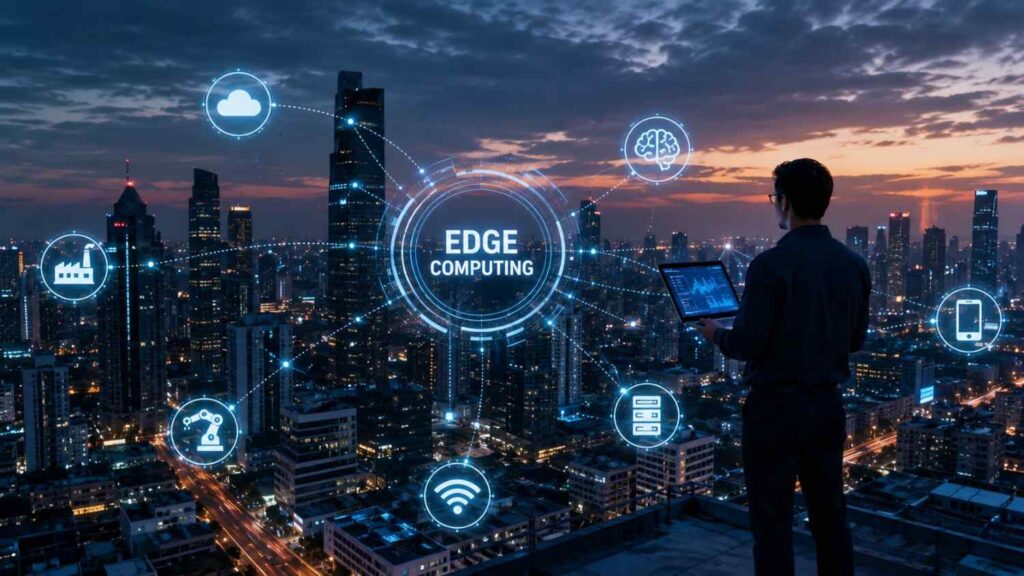
The Rise of Edge Computing: What It Means for Businesses
The rise of edge computing is changing where businesses process information and make operational decisions. Traditionally, applications sent data from devices, shops, machines, sensors, vehicles, and branch locations to a central data centre or public cloud. The central platform processed the information and returned a result.
That model still works well for many applications. However, it becomes less practical when a process needs an immediate response, generates large amounts of raw information, operates in an unreliable network environment, or must keep selected data within a specific location.
Edge computing places selected computing and storage resources closer to the source or user of information. AWS explains that this model can improve application performance, reduce bandwidth requirements, and provide faster real-time insights.
A high-resolution industrial camera, for example, may generate a continuous video stream. The company may not need to transfer and store every frame. A local edge system can analyze the video, identify a safety concern or defective product, trigger an immediate response, and send only the relevant result to the cloud.
The technology is also becoming more closely connected to AI. Edge AI runs machine-learning inference close to where data is collected, supporting applications such as computer vision, anomaly detection, speech processing, robotics, and intelligent automation.
For business leaders, the most useful question is not whether edge computing is popular. The better question is where local processing can produce a measurable improvement in speed, resilience, cost, safety, quality, privacy, or customer experience.
What Edge Computing Is and How It Differs From the Cloud
Edge computing is a distributed technology model in which computing, storage, analytics, or artificial intelligence is placed closer to the devices and locations generating or consuming information. The edge may be a small IoT device, an industrial gateway, a shop server, a factory cluster, a telecommunications site, a vehicle, or a rugged computing unit at a remote location.
The exact position of the edge depends on the workload. A sensor may perform simple filtering before transmitting a reading. A gateway may combine information from several machines. A local server may run computer-vision models across multiple cameras. A telecommunications provider may host an enterprise application within a Multi-access Edge Computing environment.
ETSI describes MEC as an environment that provides cloud-computing capabilities and IT services at the network edge. It is characterized by low latency, high bandwidth, and access to real-time network information. MEC can be deployed on premises or within network-edge locations and is not limited to mobile access; fixed and wireless local-area networks may also be supported.
Edge computing vs cloud computing should not be treated as a simple competition. Cloud platforms provide centralized services, elastic computing capacity, large-scale storage, global analytics, and organization-wide coordination. Edge computing provides local responsiveness, filtering, resilience, and operational control.
Most enterprises therefore adopt a hybrid model. Immediate operational actions happen locally, while aggregated results move to the cloud for reporting, model training, long-term storage, and coordination. The architecture succeeds when each workload is placed according to latency, connectivity, security, cost, and management requirements.
| Requirement | Central Cloud | Edge Computing | Hybrid Approach |
|---|---|---|---|
| Immediate local response | May be affected by network delay | Strong fit | Edge handles urgent actions |
| Long-term storage | Strong fit | Usually limited | Store recent data locally and history centrally |
| Unreliable connectivity | Services may be interrupted | Can continue selected local functions | Synchronize after reconnection |
| Organization-wide analytics | Strong fit | Limited local view | Aggregate edge results centrally |
| Data-location control | Depends on architecture and region | Can retain selected information locally | Apply placement rules by data type |
| Fleet coordination | Centralized control is easier | Infrastructure is geographically distributed | Central platform manages the edge fleet |
How Data Moves Through an Edge Architecture
A typical edge architecture begins with devices that generate information, such as cameras, sensors, production machinery, mobile equipment, medical devices, or point-of-sale systems. Data may be processed directly on the device or transferred to a nearby gateway, server, appliance, or edge cluster.
The local system can remove irrelevant events, combine multiple readings, execute business rules, run an AI model, and trigger an immediate action. Only selected data may then move to the cloud. AWS explains that edge systems can separate redundant information, data requiring long-term storage, and information needing immediate action.
A factory camera could inspect every manufactured item locally. When it identifies a defect, the edge system can reject the item immediately, retain supporting evidence, and send defect statistics to the company’s central analytics platform. The organization avoids transferring every video frame while preserving useful business information.
Cloud-to-edge movement is equally important. A central team may train an updated AI model, approve a configuration, or change a safety rule. That update must then be delivered securely to relevant edge locations.
A scalable architecture therefore requires secure two-way communication, device identity, version control, monitoring, remote deployment, rollback capabilities, and defined data-placement rules. Without these controls, a successful single-site pilot may become difficult to manage across hundreds of locations.
Why Hybrid Edge and Cloud Models Are Common
Most organizations do not need to move completely away from centralized cloud infrastructure. They need a hybrid architecture that combines local responsiveness with centralized management, storage, and scale.
Cloud environments remain effective for training large machine-learning models, storing historical records, performing cross-location analytics, coordinating identities, and managing applications that can tolerate network delay. Edge systems are valuable when decisions must happen quickly, raw data is expensive to move, local operations must continue during an outage, or sensitive information should remain at a particular site.
Google Distributed Cloud demonstrates this hybrid approach by extending Google Cloud infrastructure and services into data centres and edge locations. Its portfolio includes connected deployments, air-gapped environments, and software-only options. Google positions these solutions for local processing, low-latency workloads, survivability, regulatory needs, and on-premises AI.
Microsoft Azure Stack Edge offers a similar workload-placement model. Microsoft describes Azure Stack Edge devices as providing computing, storage, networking, and hardware-accelerated machine learning at edge locations. Supported workloads can include virtual machines and containerized applications.
Organizations evaluating distributed architectures can also review practical examples of hybrid cloud infrastructure to better understand how cloud resources and edge environments can work together across different deployment scenarios.
The better architectural question is therefore not “edge or cloud?” It is “which parts of this workload belong at each location?” That approach allows the business to balance speed, cost, resilience, governance, and operational simplicity.
| Business Workload | Best Processing Location | Primary Business Benefit | Typical Industry |
|---|---|---|---|
| Machine quality inspection | Edge | Instant defect detection | Manufacturing |
| Point-of-sale transactions | Edge | Faster checkout during outages | Retail |
| AI video surveillance | Edge | Lower bandwidth usage | Security & Smart Cities |
| Predictive maintenance analytics | Edge + Cloud | Real-time alerts with centralized reporting | Manufacturing & Energy |
| Historical business reporting | Cloud | Long-term analytics and storage | All Industries |
| AI model training | Cloud | High-performance computing resources | Enterprise IT |
| Fleet monitoring | Hybrid | Local processing with centralized visibility | Logistics |
| Customer behavior analytics | Hybrid | Faster local insights and business intelligence | Retail |
Business Benefits of Edge Computing
The business benefits of edge computing usually come from faster decisions, lower unnecessary data movement, stronger operational continuity, and the ability to use AI within physical locations. These benefits are valuable only when they connect to a measurable business outcome.
Latency is often the clearest advantage. A machine, vehicle, camera, or customer-facing application may need to respond faster than a distant cloud round trip allows. Processing data nearby can shorten the time between an event and an action. In business terms, that may mean rejecting a defective product sooner, detecting a safety risk, reducing checkout delay, or responding immediately to equipment abnormalities.
Bandwidth is another important consideration. Video systems, industrial sensors, and connected machinery may produce more raw data than a company needs to store or analyze centrally. Edge systems can filter the data and send alerts, exceptions, or summaries rather than every event.
Operational resilience also matters. Shops, mines, ships, energy facilities, transport systems, and remote offices may experience weak or interrupted connectivity. Selected business processes can continue locally and synchronize with central systems after the connection returns.
Local processing can also support data sovereignty and privacy strategies by reducing the amount of raw information leaving a site. However, local processing does not automatically create security or regulatory compliance. The company must still define access, retention, encryption, auditing, and deletion controls.
Finally, edge AI makes intelligent automation practical where information is generated. NVIDIA identifies the convergence of AI, IoT sensors, cloud-native applications, and modern networks as a major driver of enterprise edge computing.
Faster Decisions and More Reliable Operations
Faster processing matters when delay creates a direct operational cost or safety risk. A production line cannot wait several seconds to determine whether an item is defective. A safety system may need to stop equipment immediately. A retailer may need to complete a transaction even when its wide-area connection is temporarily unavailable.
Edge computing reduces the physical and network distance between the source of information and the system responding to it. ETSI describes network-edge environments as supporting low-latency and high-bandwidth applications, while AWS highlights immediate machine response and disconnected operation as important edge capabilities.
Reliability is equally important. A cloud-only application may become unavailable when a site loses connectivity. An edge-enabled application can continue performing selected functions locally and forward data when the network is restored.
Businesses should identify which processes must continue and for how long. A retailer may allow local payments but postpone loyalty-account synchronization. A factory may continue quality inspection while storing results locally. A remote energy facility may keep safety monitoring active while delaying large data transfers.
The benefit should be measured in operational language rather than only technical metrics. Relevant outcomes include reduced downtime, fewer rejected transactions, faster detection, lower defect rates, safer operations, and improved customer experience.
Latency is a technical measurement. Business value comes from what the organization can achieve with the faster response.
Lower Data Movement and Smarter Use of Cloud Resources
Transferring large volumes of raw information can consume network capacity and increase cloud storage and processing requirements. Edge computing allows an organization to decide which information should be processed, retained, summarized, or transmitted.
A local video-analysis system may discard routine footage after processing while keeping incidents and supporting evidence. A sensor gateway may calculate averages, detect unusual patterns, and send only meaningful changes. A retail location may process operational information locally while transferring aggregated results to a central reporting system.
AWS identifies reduced bandwidth use and faster local insights as potential advantages of edge computing.
Organizations should not assume that local processing automatically reduces total technology costs. Edge devices must be acquired or subscribed to, installed, secured, powered, monitored, updated, supported, and eventually replaced. Savings from reduced data movement must therefore be compared with the cost of managing distributed infrastructure.
A realistic financial assessment should include:
- Network-transfer requirements
- Central compute and storage
- Edge hardware or service charges
- Site preparation and installation
- Security and remote monitoring
- Software deployment and support
- Hardware maintenance and replacement
- Downtime avoided
- Process improvement
- Revenue or safety benefits
The best architecture is not necessarily the one that sends the least data to the cloud. It is the architecture that processes each type of information in the location that creates the best balance of performance, cost, governance, and operational control.
Edge Computing Use Cases Across Industries
Edge computing is especially useful where digital systems interact directly with physical operations. Manufacturing, retail, logistics, healthcare, transportation, telecommunications, energy, and media all contain workloads that benefit from faster local processing, lower data transfer, or reduced dependence on continuous cloud connectivity.
Manufacturers can use edge AI for visual inspection, predictive maintenance, safety monitoring, robotics, and machine coordination. Retailers can support local checkout, queue analysis, inventory visibility, loss prevention, and more responsive customer experiences. Warehouses and logistics companies can process tracking, sorting, and equipment data close to operational activity.
Energy and utility organizations operate equipment in remote or difficult environments. Edge systems can process information near wind turbines, pipelines, solar installations, offshore sites, and substations. Local analysis may support safety, maintenance, and continued operation during connectivity interruptions.
Healthcare organizations may use local systems for device monitoring, imaging workflows, alerts, and privacy-sensitive processing. These applications require careful validation because technical errors may affect clinical work or sensitive patient information.
Telecommunications providers use Multi-access Edge Computing to host applications closer to users and enterprise sites. ETSI describes MEC as a bridge between telecommunications and cloud environments and supports deployment from on-premises locations to the wider network edge.
Interactive media, gaming, augmented reality, and content delivery can also benefit from geographically distributed processing. The common factor is not a particular industry. It is a requirement for local speed, local availability, efficient handling of high-volume data, or tighter control over where processing occurs.
Manufacturing, Retail, and Logistics
Manufacturing is one of the clearest enterprise edge environments because factories generate continuous information from production equipment, sensors, robots, controllers, and cameras.
Computer-vision systems can inspect products locally and identify defects without sending every image to a central platform. Predictive-maintenance applications can analyze heat, vibration, sound, pressure, or power patterns and alert teams before equipment failure. Safety systems can recognize hazards and trigger immediate responses.
Google identifies industrial use cases such as video-based anomaly detection, factory optimization, asset protection, and real-time inventory as examples for distributed edge infrastructure.
Retailers can use edge systems for checkout continuity, queue monitoring, inventory analysis, store analytics, and loss prevention. Local applications may continue selected operations during wide-area network interruptions.
In logistics, edge computing can support warehouses, ports, distribution centres, and vehicle fleets. Local analytics may improve automated sorting, package tracking, route decisions, loading efficiency, and equipment monitoring.
The challenge is operational scale. A solution that works in one carefully managed facility may need to operate across hundreds of sites with different hardware, layouts, network conditions, and support capabilities.
Businesses should therefore define standard hardware profiles, remote updates, access controls, monitoring, rollback processes, and ownership before expansion. The technology creates value only when the organization can operate it reliably across every intended location.
Healthcare, Energy, Telecommunications, and Customer Experiences
Healthcare edge systems can process information close to patients, clinicians, or medical equipment. Possible applications include device monitoring, imaging analysis, local alerts, and privacy-sensitive workflows. Local processing may reduce the amount of raw patient information transmitted to central systems, but healthcare deployments still require strong clinical validation, governance, security, and auditing.
Energy organizations frequently operate equipment in areas with limited connectivity. Edge systems can collect and analyze information from wind turbines, solar farms, pipelines, offshore facilities, mines, and substations. Local processing can support safety monitoring, predictive maintenance, and operational continuity.
Telecommunications providers can combine 5G and Multi-access Edge Computing to host applications closer to users or enterprise operations. ETSI states that MEC can support mobile, fixed, and WLAN access and can be deployed from on-premises systems to broader network-edge locations.
Customer-facing applications may also benefit. Interactive media, gaming, augmented reality, intelligent kiosks, and personalized digital experiences often need responsive, geographically distributed computing.
NVIDIA identifies retail, healthcare, manufacturing, robotics, and scientific computing among the environments in which real-time edge AI can be applied.
Before choosing edge technology, businesses should confirm that local processing solves a real limitation. In some cases, improving the existing application, network, caching strategy, or cloud architecture may provide a simpler and less expensive solution.
Related Articles
Risks and How to Build an Edge Computing Strategy
Edge computing creates valuable capabilities, but it also distributes infrastructure beyond the controlled boundaries of a central data centre. This can increase cybersecurity, operational, governance, and lifecycle-management complexity.
An organization may need to manage servers, gateways, containers, models, certificates, identities, logs, and application versions across many physical locations. Some systems may be installed in shops, factories, vehicles, telecommunications sites, or remote facilities where physical access is difficult to control.
NIST explains that attack surfaces in cloud and edge environments have shifted and, in some cases, significantly increased. Its guidance recommends a layered security approach beginning with the trustworthiness of the underlying hardware and platform.
Distributed systems may also develop configuration drift. One location may run an outdated application, expired certificate, or older AI model. Devices may lose contact with central management, run out of storage, experience hardware failure, or continue operating with incomplete information.
The solution is to treat edge computing as a managed platform rather than a collection of isolated appliances. A sound edge computing strategy begins with a defined business problem, a measurable baseline, and a controlled pilot.
The architecture should specify which workloads run locally, which remain in the cloud, and how information moves between them. Security, remote deployment, observability, support, recovery, and hardware replacement should be designed before large-scale expansion.
Edge adoption is therefore both a technology decision and an operating-model decision. A successful technical demonstration may still fail commercially when the company cannot update, monitor, support, and secure the deployment efficiently.
As edge computing initiatives grow, many organizations also evaluate technology leadership hiring to ensure they have the expertise needed to manage distributed infrastructure, cybersecurity, and large-scale digital transformation projects.
Security, Governance, and Operational Challenges
Distributed infrastructure creates more physical and digital locations that must be inventoried, authenticated, patched, monitored, and protected. Edge devices may also be more exposed to physical access than systems operating inside controlled data centres.
NIST recommends layered platform security and discusses technologies such as roots of trust, trusted execution environments, hardware security modules, secure enclaves, and platform-integrity controls.
ENISA describes fog and edge computing as important 5G enablers that create new applications alongside security challenges involving telecommunications, cloud, and industrial environments.
An enterprise edge security plan should address:
- Unique device and workload identities
- Secure boot and platform verification
- Encrypted communications
- Protected local storage
- Least-privilege access
- Signed software and model updates
- Central asset inventory
- Patch and certificate management
- Monitoring and alerting
- Physical tamper protection
- Secure device decommissioning
Data governance must define what may remain local, what may move centrally, how long data is retained, and which teams can access it.
The organization also needs a disconnected-operation policy. It should explain what happens when a location loses contact with central management, misses an update, or receives conflicting configuration.
A secure edge architecture assumes that devices will sometimes be remote, unavailable, or physically exposed. Controls must be designed around those realities.
A Step-by-Step Edge Adoption Framework
Begin with one measurable business outcome. Suitable examples include reducing product defects, preventing equipment downtime, maintaining essential operations during connectivity loss, or lowering the amount of raw video transferred to the cloud.
Record a baseline before introducing new technology. Measure response time, downtime, bandwidth use, defect rate, operating cost, or another relevant outcome. Without a baseline, a pilot may demonstrate technical capability without proving business value.
Use the following process:
- Select the workload: Choose a process with a clear need for local computing.
- Map the data: Identify its source, volume, sensitivity, retention, and destination.
- Place the workload: Decide what runs on devices, gateways, local servers, and cloud platforms.
- Define resilience: Document offline behaviour and synchronization.
- Design security: Address identity, access, updates, storage, and monitoring.
- Run a pilot: Test one representative site or user group.
- Measure results: Compare the outcome with the baseline.
- Design operations: Establish remote deployment, support, recovery, and replacement.
- Scale gradually: Expand only after the operating model works.
One thing I always check before scaling is whether the team can identify, update, secure, and observe every deployed component remotely.
A successful edge programme requires a repeatable lifecycle, not merely a working demonstration at one carefully managed location.
| Evaluation Area | Why It Matters for Businesses | Readiness Indicator |
|---|---|---|
| Network Latency | Determines whether real-time processing is required | Low-latency operations are business critical |
| Data Volume | High data generation increases bandwidth costs | Large amounts of sensor or video data |
| Connectivity Reliability | Supports business continuity during outages | Remote or unstable network environments |
| Security Requirements | Protects distributed devices and sensitive data | Strong identity and device management policies |
| AI Processing Needs | Enables local AI inference for faster decisions | AI-powered applications require instant responses |
| Regulatory Compliance | Keeps sensitive information within required locations | Data residency or privacy regulations apply |
| IT Management Capability | Simplifies monitoring and software updates | Centralized remote device management available |
| Business ROI | Ensures measurable value before scaling | Pilot project demonstrates operational improvements |
Quick Answer About The Rise of Edge Computing: What It Means for Businesses
Edge computing moves selected processing, storage, analytics, and artificial intelligence closer to the devices, machines, people, or locations generating information. Instead of transmitting every event to a distant cloud region, an edge system can analyze data locally, take immediate action, and send only useful results to a central platform. AWS describes edge computing as bringing computing and storage closer to the devices producing information and the users consuming it.
For businesses, this architecture can reduce response time, lower unnecessary network traffic, support operations during connectivity interruptions, and enable real-time AI in factories, shops, healthcare facilities, vehicles, telecommunications networks, and remote industrial sites. It can also help organizations control where sensitive or high-volume data is processed.
Edge computing does not usually replace cloud computing. The cloud remains valuable for centralized management, historical storage, organization-wide analytics, application coordination, and large-scale AI model training. Edge systems handle workloads that require local speed, resilience, filtering, or privacy.
The business opportunity is significant, but implementation creates new responsibilities. Companies must manage distributed hardware, device identity, cybersecurity, software updates, observability, data governance, lifecycle management, and physical security. The strongest strategy begins with a measurable operational problem rather than a technology-first deployment.
Why Edge Computing Is Growing Now
The rise of edge computing is closely connected to the growth of connected equipment, industrial sensors, video systems, artificial intelligence, computer vision, 5G networks, and applications that require immediate decisions. Transferring every camera frame, machine reading, or customer interaction to a distant cloud can create unnecessary delay and network traffic.
Modern edge systems can filter raw information, run machine-learning inference, identify exceptions, and trigger local actions. They may send only alerts, summaries, or selected records to the cloud. NVIDIA describes edge AI as processing data close to where it is collected, allowing businesses to analyze information in real time without transmitting every event to a central data centre.
Distributed-cloud platforms are also making edge deployments easier to manage. Google Distributed Cloud extends cloud infrastructure into data centres and edge locations for local processing, low-latency workloads, survivability, regulatory requirements, and on-premises AI.
Telecommunications infrastructure adds another layer. ETSI Multi-access Edge Computing provides cloud-computing capabilities at the network edge and supports low-latency, high-bandwidth applications across cellular, fixed, and wireless access networks.
The Main Business Message
The main business message is that edge computing should be adopted to solve a defined operational limitation, not simply because it is receiving attention. The strongest business cases usually involve time-sensitive decisions, expensive data transfers, unreliable connectivity, sensitive local information, or large volumes of machine-generated data.
A factory may need to identify a defective product before it moves to the next stage. A retailer may need local checkout and inventory functions to continue when external connectivity is unstable. An energy company may need to analyze equipment data at a remote site where continuous cloud access is unavailable.
Not every workload belongs at the edge. Central cloud platforms remain suitable for long-term storage, cross-location reporting, application coordination, large-scale analytics, and AI model training. Edge environments are better suited to immediate local decisions, filtering, disconnected operation, and data requiring location-specific control.
I recommend beginning with three questions:
- Which decisions must happen locally?
- Which information can be processed centrally?
- Which data needs to move between edge and cloud environments?
These questions lead to a hybrid design in which each workload runs in the most appropriate location. AWS also presents edge and cloud computing as complementary models rather than direct replacements.
Frequently Asked Questions
The rise of edge computing raises practical questions about architecture, cost, security, AI, cloud replacement, industry suitability, and implementation. These questions matter because edge computing is not one product or a single deployment model. It may range from lightweight processing inside an IoT device to a local Kubernetes cluster, private telecommunications environment, or air-gapped distributed-cloud platform.
Businesses should be cautious about broad claims that edge computing is always faster, cheaper, more private, or more reliable than the cloud. Its value depends on the workload, network conditions, data volume, operational requirements, and ability to manage distributed infrastructure.
A low-latency manufacturing process may benefit significantly from local processing. A conventional office application with reliable connectivity and no urgent local decisions may gain little from additional edge hardware.
Security also requires careful interpretation. Keeping information local can reduce certain transfers, but it also creates more devices and locations to secure. NIST and ENISA both emphasize the changing attack surface and security complexity associated with edge and distributed environments.
The answers below address the most common business questions in clear language. They should be used as a decision framework rather than a replacement for technical assessment.
A responsible evaluation should compare edge computing with alternative solutions, including application optimization, better networking, caching, conventional cloud architecture, and on-premises infrastructure. The objective is to select the simplest architecture capable of meeting the business requirement.
What Is Edge Computing in Simple Terms?
Edge computing means processing selected information close to where it is generated or used instead of sending everything to a distant central cloud or data centre.
The edge could be a sensor, camera, gateway, shop server, factory computer, telecommunications location, vehicle, or remote-site appliance. AWS defines edge computing as bringing storage and computing capabilities closer to the devices producing information and the users consuming it.
For example, a security camera can use a local AI model to identify a safety incident. It sends an alert and relevant evidence to the central platform rather than continuously transferring every frame.
This approach is useful when a process needs an immediate response, must continue during network interruptions, generates large quantities of data, or requires selected information to remain local.
Edge computing does not mean that the cloud disappears. The cloud can still manage devices, store long-term information, coordinate applications, train AI models, and analyze results from many locations.
In simple terms, edge computing handles urgent or location-sensitive work nearby, while the cloud manages broader and more centralized activities.
Will Edge Computing Replace Cloud Computing?
Edge computing is unlikely to replace cloud computing for most organizations. The two models provide different strengths and commonly operate together.
Cloud platforms are well suited to centralized application management, elastic computing, long-term storage, cross-location reporting, organization-wide analytics, and large-scale AI model training. Edge environments are more suitable for immediate local decisions, data filtering, disconnected operation, and workloads affected by latency or bandwidth limits.
Google Distributed Cloud and Microsoft Azure Stack Edge both reflect this hybrid approach by extending cloud services, infrastructure, or management into data centres and edge locations.
A manufacturing company might train a computer-vision model in a central cloud, deploy it to factory edge servers, and send defect statistics back to the central platform. A retailer may process checkout locally while synchronizing inventory and customer information centrally.
The correct question is therefore not whether edge will defeat or replace the cloud. It is which workload components should run in each environment.
Businesses should evaluate response-time requirements, connectivity, data volume, security, cost, and operational management. The resulting architecture may use public cloud, private cloud, data-centre systems, network edge, and device-level processing together.
What Are the Main Benefits of Edge Computing?
The main business benefits of edge computing include faster local decisions, reduced transfer of unnecessary raw data, continued operation during certain connectivity problems, and the ability to run AI close to physical activity.
A local application can react to a machine failure, safety event, stock shortage, or customer request without waiting for a distant cloud response. High-volume sensor or video data can be filtered locally so that only relevant events are transmitted.
Edge systems may also continue performing selected tasks when an external connection becomes unavailable. AWS highlights real-time processing, reduced bandwidth requirements, and support for remote or poorly connected operations as important edge characteristics.
Local processing can support data-location and privacy strategies by limiting the transfer of selected raw information. However, compliance still depends on access controls, retention policies, auditing, encryption, and governance.
The value should be measured through business outcomes rather than only technical improvements. Useful measures include reduced downtime, faster service, fewer defects, improved safety, lower network use, and better customer experience.
Edge computing is beneficial when those improvements exceed the cost and complexity of deploying and managing the distributed infrastructure.
What Are the Biggest Edge Computing Risks?
The biggest risks include a larger distributed attack surface, inconsistent software versions, device compromise, physical exposure, configuration drift, fragmented data, hardware failure, and difficulty monitoring many locations.
NIST notes that cloud and edge attack surfaces have shifted and may be significantly larger. It recommends a layered security approach beginning with trustworthy hardware and platforms.
A device located in a shop, vehicle, factory, or remote facility may be more physically accessible than a server in a secured data centre. It may also lose contact with central management and miss updates or certificate renewals.
Operational complexity is another risk. Each edge location may require power, networking, hardware maintenance, logging, monitoring, replacement, and support.
Businesses should use unique identities, encrypted communication, secure boot, signed updates, protected storage, least-privilege access, centralized inventory, and remote monitoring. They should also define what happens when a device is disconnected or compromised.
Edge computing can be secure, but security must be designed for distributed and sometimes physically exposed infrastructure. Treating edge devices as trusted simply because they are located on business premises creates unnecessary risk.
Which Businesses Benefit Most From Edge Computing?
Businesses benefit most when they operate connected equipment, machines, sensors, cameras, remote locations, low-latency applications, or high-volume data sources.
Manufacturing can use edge systems for visual inspection, predictive maintenance, safety monitoring, and robotics. Retailers can support checkout continuity, queue analysis, inventory detection, and in-store analytics. Logistics companies may improve sorting, tracking, equipment monitoring, and fleet operations.
Energy organizations can process information near pipelines, turbines, solar installations, mines, and offshore facilities. Telecommunications providers can use MEC to host applications closer to users and enterprise sites. Healthcare organizations may process selected medical-device or imaging data locally, subject to strict validation and governance.
Interactive gaming, media, augmented reality, and customer-experience applications may also benefit from geographically distributed processing.
The strongest indicator is not industry alone. It is the presence of a business requirement involving immediate response, unreliable connectivity, high data volume, or local data control.
A company should not adopt edge computing merely because competitors mention it. It should identify a specific limitation, compare alternative solutions, and measure whether local processing improves the outcome enough to justify the additional infrastructure.
How Should a Small Business Start With Edge Computing?
A small business should begin with one narrow problem rather than building a broad enterprise edge platform.
A retailer might test local checkout continuity during internet interruptions. A warehouse could monitor one important machine for abnormal vibration. A security team might process camera events locally and send only relevant alerts. These projects have defined users, measurable outcomes, and limited infrastructure requirements.
Start by recording the current problem. Measure downtime, response time, bandwidth consumption, manual effort, or another relevant business outcome.
Next, identify the minimum local hardware and software required. Managed edge services or appliances may reduce the need to design infrastructure from the beginning. Microsoft, Google, AWS, and other providers offer products that extend cloud capabilities into local or edge environments, although availability and suitability differ by workload.
Test security, remote updates, backup, monitoring, and failure recovery during the pilot. Do not evaluate only processing speed.
After the pilot, compare the result with the baseline and calculate the full operating cost. Expand only when the business improvement is clear and the company can support the deployed system without constant manual intervention.
Conclusion
The rise of edge computing is giving businesses more flexibility over where information is processed and where decisions are made. Instead of depending on a central cloud for every event, organizations can place selected computing resources closer to machines, employees, customers, devices, and remote operations.
This architecture can provide faster response, reduce unnecessary data transfer, support selected operations during network interruptions, and make real-time edge AI practical. Manufacturing, retail, logistics, energy, telecommunications, healthcare, and interactive customer applications all contain potential use cases.
However, edge computing is not automatically faster, cheaper, more private, or more secure in every situation. Distributed infrastructure introduces hardware costs, cybersecurity risks, update requirements, support responsibilities, and data-governance challenges. NIST and ENISA both emphasize the changing security landscape created by cloud, edge, fog, and 5G environments.
The strongest strategy is usually hybrid. Urgent, sensitive, or high-volume information can be processed locally. The cloud can provide centralized management, historical storage, reporting, coordination, and model training.
Businesses should begin with a measurable operational problem and a limited pilot. They should prove both business value and remote manageability before expanding across multiple locations.
The Rise of Edge Computing: What It Means for Businesses is ultimately a story about workload placement. Organizations now have more options for deciding where applications, data, and AI should run. Success depends on making that decision according to business requirements rather than technology trends.
The Key Points to Remember
Edge computing brings selected computing, storage, analytics, and AI closer to the source or user of information. It is most useful when an application requires immediate response, must continue during connectivity interruptions, generates large volumes of raw data, or benefits from local control.
The cloud remains important. Edge and cloud systems usually complement one another rather than compete.
The most important potential advantages include:
- Faster local decisions
- Reduced transfer of unnecessary data
- Better resilience at remote or disconnected sites
- Local AI inference
- Greater flexibility over data placement
- Improved support for physical operations
The main challenges include cybersecurity, device management, updates, hardware lifecycle, data consistency, and operational scale.
A strong implementation connects these technical capabilities to measurable outcomes such as reduced downtime, fewer production defects, improved safety, faster customer service, or lower network use.
The organization must also manage the edge fleet remotely. A solution requiring frequent manual intervention at every site will be difficult to scale.
Edge computing should therefore be treated as a business architecture decision supported by IT, operations, cybersecurity, data, and application teams. Its success depends as much on lifecycle management as on local computing performance.
Your Best Next Action
Select one business process in which network delay, poor connectivity, high data volume, or local data requirements create a genuine limitation.
Document the current workflow and measure its performance. Record response time, bandwidth use, downtime, error rate, operational cost, or another meaningful metric.
Map the data involved. Decide which events require immediate local action, which information should remain temporarily at the site, and which information should move to a central platform.
Create a controlled pilot using representative hardware, software, network conditions, security controls, and data volumes. Evaluate deployment, updates, monitoring, failure recovery, support, and hardware replacement alongside technical performance.
Compare the pilot result with the original baseline. A successful project should show an operational, financial, safety, or customer-experience improvement.
Finally, evaluate whether the management model can scale. Confirm that the organization can remotely identify, update, secure, monitor, recover, and decommission every component.
This method reduces the risk of investing in a large distributed platform before proving that edge computing solves a valuable business problem. It also produces practical evidence for leadership, security, operations, and finance teams.