
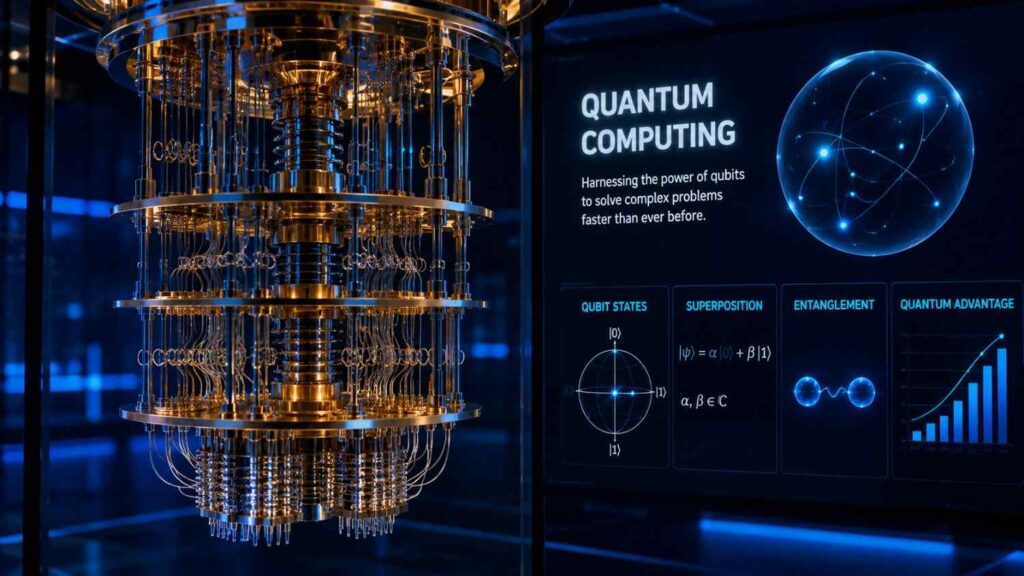
What is Quantum Computing? A Beginner’s Guide
What is Quantum Computing? A Beginner’s Guide is a clear introduction to one of the most important emerging technologies in modern computer science. Quantum computing uses ideas from quantum mechanics, the branch of physics that studies matter and energy at very small scales. At that level, particles do not always behave like everyday objects. They can exist in special states, become connected in unusual ways, and create probability patterns that can be used for computation.
For beginners, the main idea is simple: quantum computers do not process information in the same way as normal computers. Classical computers use bits, while quantum computers use qubits. This difference changes how information is stored, transformed, and measured. The result is a computing model that may be useful for certain scientific, mathematical, and industrial problems.
In my experience, the biggest mistake people make is thinking quantum computers are simply “super-fast computers.” That is not accurate. Quantum computers are not designed to replace laptops, smartphones, or cloud servers for everyday tasks. They are specialized machines that may help solve problems involving complex systems, large search spaces, and quantum behavior itself.
What Is Quantum Computing in Simple Terms?
Quantum computing is a way of computing that uses quantum bits, called qubits, instead of ordinary bits. A classical bit can only hold one of two values at a time: 0 or 1. This binary system powers almost every digital device we use today, including phones, laptops, websites, banking systems, and business software. Quantum computing works differently because qubits can exist in quantum states that behave more flexibly before they are measured.
This does not mean a qubit is simply “both 0 and 1” in the same way a normal object could hold two labels. A better beginner explanation is that a qubit carries probability information. Before measurement, its state can be described as a combination of possible outcomes. When measured, the qubit gives a definite result. This is why quantum computing often sounds strange at first. It is built on probability, measurement, and carefully controlled quantum behavior.
NIST explains that qubits can be in state 0, state 1, or a superposition of both before measurement. This property is one reason quantum computers may be useful for certain complex calculations. However, quantum computers are also very sensitive to noise and errors. That makes them powerful in theory but difficult to build and operate in practice.
The Basic Definition
In simple terms, quantum computing is computing based on quantum mechanics. It uses physical systems such as atoms, ions, photons, or superconducting circuits to represent and process information. These systems behave according to quantum rules, which are different from the rules we experience in everyday life. Microsoft explains that quantum systems can exist in special states that make quantum computation possible.
A beginner-friendly definition would be this: quantum computing is a technology that uses qubits and quantum effects to solve selected types of problems in new ways. The word “selected” is important. Quantum computers are not automatically better for every calculation. They need suitable algorithms and carefully designed hardware. When the problem fits the quantum model, quantum computing may offer advantages. When the problem does not fit, classical computing may remain faster, cheaper, and more reliable.
Why Quantum Computers Are Different
Quantum computers are different because they use quantum states instead of ordinary binary states. In classical computing, information is stored as bits that are either 0 or 1. In quantum computing, qubits can hold probability-based states before measurement. This allows a quantum system to represent and manipulate information in a way that has no direct classical equivalent.
IBM highlights several core concepts behind quantum computing, including superposition, entanglement, interference, and decoherence. These ideas work together. Superposition allows a qubit to hold a flexible quantum state. Entanglement creates strong relationships between qubits. Interference helps increase the probability of useful results and reduce the probability of less useful ones. Decoherence is the challenge that appears when a quantum state is disrupted by its environment. These features make quantum computers very different from classical machines, but they also make them much harder to control.
What Quantum Computing Is Not
Quantum computing is not magic, and it is not a guaranteed shortcut for every hard problem. It is also not a replacement for classical computing. Everyday tasks such as browsing websites, editing documents, running online stores, processing payments, managing databases, or watching videos are still best handled by classical systems. Those systems are stable, affordable, and already optimized for general use.
Quantum computing is better understood as a specialized tool for specific problems. These problems may include simulating molecules, exploring materials, improving some optimization methods, and preparing for future cryptography risks. A quantum computer also does not “try every answer at once” in a simple way. That phrase is common, but it can be misleading. Quantum algorithms must be carefully designed so that useful results become more likely when the final measurement happens. Without the right algorithm, a quantum computer offers no practical advantage.
How Quantum Computing Works
Quantum computing works by preparing qubits, applying quantum operations to them, and then measuring the final state to get a classical result. This sounds simple, but each step requires very careful control. Qubits are fragile, and their quantum states can be disturbed by heat, vibration, electromagnetic noise, or unwanted interaction with the environment. That is why many quantum computers need highly controlled laboratory conditions.
The process usually begins with initializing qubits into a known starting state. Then a quantum circuit applies operations called gates. These gates change the qubits’ states according to the rules of quantum mechanics. Some gates create superposition. Others create entanglement between qubits. The algorithm is designed so that, through interference, wrong or less useful outcomes become less likely and useful outcomes become more likely.
After the circuit runs, the qubits are measured. Measurement converts quantum information into classical information, usually a string of 0s and 1s. Because quantum results are probabilistic, the same circuit may need to run many times to produce a reliable pattern. This is one reason quantum computing is both powerful and difficult. It uses probability as a resource, but it must manage error, noise, and uncertainty carefully.
Qubits, Superposition, and Measurement
A qubit is the basic unit of information in a quantum computer. IBM explains that a qubit can be represented as a quantum state connected to probabilities, unlike a classical bit that holds a fixed 0 or 1. This is one of the first ideas beginners should understand because it separates quantum computing from normal computing.
Superposition means a qubit can exist in a combination of possible states before measurement. However, when the qubit is measured, it gives a definite classical result. That result may be 0 or 1, depending on the probabilities created by the quantum circuit. This is why quantum computing is not about reading all possible answers directly. Instead, it is about designing operations that shape probabilities in a useful way. A good quantum algorithm increases the chance of measuring the answer that helps solve the problem.
| Concept | Simple Meaning | Why It Matters |
|---|---|---|
| Qubit | The basic unit of information in a quantum computer | Stores quantum information differently from classical bits |
| Superposition | A qubit can represent multiple possible states before measurement | Allows quantum computers to explore many possibilities efficiently |
| Measurement | The process of reading a qubit’s state | Produces the final classical result (0 or 1) |
| Entanglement | A connection between two or more qubits | Helps qubits work together in ways classical bits cannot |
| Quantum Interference | Strengthens correct outcomes and weakens incorrect ones | Improves the probability of getting the right answer |
| Quantum Circuit | A sequence of quantum operations performed on qubits | Executes quantum algorithms to solve problems |
Entanglement and Interference
Entanglement is a quantum relationship between two or more qubits. When qubits are entangled, the state of one qubit cannot be fully described without considering the state of the other. Microsoft describes entanglement as a quantum correlation where individual qubits cannot be fully understood independently from the whole system.
Interference is another key concept. It helps quantum algorithms guide results by strengthening some probability patterns and weakening others. In a useful quantum computation, the algorithm is designed so that paths leading to wrong answers cancel out or become less likely, while paths leading to better answers become more likely. This is one reason quantum computing is not easy to explain through simple “parallel computing” language. A quantum computer does not just run many normal calculations at once. It uses quantum behavior to create and control probability patterns.
Quantum Circuits and Algorithms
Quantum circuits are the step-by-step structures used to run quantum computations. A circuit applies a sequence of gates to qubits. These gates change the quantum state, create superposition, link qubits through entanglement, and prepare the system for measurement. In beginner language, a quantum circuit is like a recipe for changing qubits in a controlled way.
Quantum algorithms are the methods built using these circuits. Two famous examples are Shor’s algorithm and Grover’s algorithm. Shor’s algorithm is important because it showed that a powerful enough quantum computer could factor large numbers efficiently, which has serious implications for some encryption systems. NIST notes that Shor’s work helped make quantum computing a national security topic because many public-key cryptographic systems depend on mathematical problems that are hard for classical computers. Grover’s algorithm is often discussed in relation to search problems, although it does not make all searching instantly easy.
Quantum Computing vs Classical Computing
Quantum computing and classical computing are not direct replacements for each other. They are different computing models with different strengths. Classical computing is based on binary bits, logical operations, and highly reliable hardware. It is mature, scalable, and used everywhere. Quantum computing is based on qubits, quantum states, and probability. It is still developing, but it may become useful for certain problems that classical systems struggle to solve efficiently.
A helpful way to compare them is to think about purpose. Classical computers are excellent for general tasks. They run operating systems, websites, databases, apps, artificial intelligence models, and business tools. Quantum computers are not built for those routine tasks. They are being developed for specialized problems where quantum behavior, complex probability structures, or massive solution spaces matter.
This is why “quantum computing vs classical computing” should not be framed as one technology defeating the other. A more realistic future is hybrid computing. In many cases, classical computers may prepare data, control the workflow, process results, and run most of the system, while quantum processors handle a narrow part of the problem. This hybrid model is already common in how quantum cloud platforms and research workflows are presented.
Simple Comparison Table
The table below gives a beginner-friendly comparison between classical computing and quantum computing. It is useful for readers who want a quick overview before learning the deeper technical details.
| Feature | Classical Computing | Quantum Computing |
|---|---|---|
| Basic unit | Bit | Qubit |
| State | 0 or 1 | Quantum state before measurement |
| Core behavior | Binary logic | Superposition, entanglement, interference |
| Best use | Everyday computing and general software | Specialized scientific and mathematical problems |
| Stability | Very stable and reliable | Sensitive to noise and decoherence |
| Current maturity | Fully mature and widely used | Developing and research-driven |
| Output | Deterministic in most normal uses | Probabilistic and measured repeatedly |
| Main challenge | Scaling cost and performance | Error correction, noise, and useful scale |
This comparison shows why quantum computing explained properly must include both promise and limitation. NIST also notes that while qubits can represent more complex combinations, measurement limits what information can be extracted directly.
Where Classical Computers Still Win
Classical computers still win in almost every everyday use case. They are reliable, affordable, programmable, and widely available. They handle web browsing, mobile apps, business systems, online banking, cloud storage, video calls, spreadsheets, gaming, and most artificial intelligence workloads. These tasks require speed, stability, memory, and predictable results. Classical systems already provide all of that very well.
Even in advanced industries, classical supercomputers remain extremely powerful. They support weather modeling, engineering simulations, machine learning, financial systems, and scientific research. Quantum computers are not replacing these machines soon. Instead, they may eventually complement them. For beginners, this point matters because it prevents unrealistic expectations. If someone asks, “Will quantum computers replace my laptop?” the clear answer is no. A laptop is built for general personal computing, while a quantum computer is built for highly specialized computation under controlled conditions.
Where Quantum Computers May Help
Quantum computers may help in areas where the structure of the problem matches quantum methods. One major area is quantum simulation. Molecules and materials already behave according to quantum mechanics, so a quantum computer may eventually model those systems more naturally than a classical computer. NIST identifies potential use cases in molecule simulation, materials science, and drug development.
Quantum computers may also help with selected optimization problems, cryptography research, and scientific discovery. However, it is important to avoid overpromising. Many possible applications are still experimental. A business should not assume that quantum computing will immediately improve every workflow. The better approach is to watch the field, understand the use cases, and identify problems where quantum methods may one day provide practical value. This makes the topic useful without turning it into hype.
Real-World Uses of Quantum Computing
Real-world uses of quantum computing are still developing, but several areas show strong long-term potential. The most realistic applications are not consumer apps or everyday business tools. They are scientific, industrial, mathematical, and cybersecurity-related problems. These are areas where classical computers may face limits because the problem space is too large, too complex, or deeply connected to quantum behavior.
The U.S. Department of Energy describes quantum information science as a field that uses quantum mechanics to store, transmit, manipulate, compute, and measure information. It also highlights superposition and entanglement as key quantum phenomena that can support new breakthroughs. This makes quantum computing part of a larger technology ecosystem that includes quantum communication, quantum sensing, and quantum materials research.
For beginners, it is useful to separate today’s reality from future potential. Today, many quantum computing applications are research-stage or early commercial experiments. Over time, better hardware, improved algorithms, and stronger error correction may make some of these applications more practical. The strongest use cases are likely to appear first in industries that already rely on advanced modeling, complex optimization, and high-value scientific research.
| Application Area | How Quantum Computing Can Help | Current Status |
|---|---|---|
| Drug Discovery | Simulate molecules to support medicine research | Active research and early development |
| Materials Science | Design stronger and more efficient materials | Research stage |
| Optimization | Improve routing, scheduling, and resource allocation | Limited real-world adoption |
| Financial Modeling | Analyze complex market scenarios and risk calculations | Experimental use cases |
| Cybersecurity | Support the transition to post-quantum cryptography | High-priority research area |
| Scientific Research | Model complex physical and chemical systems | One of the most promising applications |
Drug Discovery and Materials Simulation
Drug discovery and materials simulation are often listed among the most promising uses of quantum computing. The reason is straightforward: molecules, atoms, and materials behave according to quantum mechanics. Classical computers can simulate many chemical systems, but the calculations become extremely difficult as systems grow more complex. A quantum computer may eventually handle some of these simulations more naturally.
NIST identifies molecule simulation, materials science, and drug development as potential areas where quantum computing could support progress. This could help researchers study chemical reactions, battery materials, catalysts, proteins, and new compounds. However, it is important to be realistic. Useful large-scale quantum simulation requires reliable qubits, lower error rates, and better quantum error correction. The opportunity is serious, but it is not instant. For now, the field is still moving from research promise toward practical workflows.
Optimization and Logistics
Optimization means finding the best solution among many possible choices. This can include delivery routes, supply chain planning, factory scheduling, energy distribution, portfolio balancing, or resource allocation. These problems can become difficult when there are many variables and constraints. Classical optimization tools are already powerful, but some problems still become expensive or slow at large scale.
Quantum computing may eventually help with certain optimization problems, especially when used in hybrid systems that combine classical and quantum methods. In these workflows, a classical computer may manage the data, while a quantum processor handles a specific part of the search or calculation. This does not mean quantum computers will automatically solve all logistics problems better. The problem must be suitable for quantum methods, and the result must be better than existing classical approaches. That is why careful testing and benchmarking matter.
Cybersecurity and Post-Quantum Cryptography
Cybersecurity is one of the most important areas connected to quantum computing. A large, fault-tolerant quantum computer could threaten some public-key cryptography systems used today. This does not mean all passwords or all encryption will suddenly fail tomorrow. It means governments, banks, cloud providers, and security teams need to prepare for a future where some current encryption methods may no longer be safe.
NIST released its first three finalized post-quantum encryption standards in August 2024 to help organizations prepare for quantum-resistant security. NIST’s post-quantum cryptography project also explains that these standards are designed to protect digital systems against future quantum threats. For beginners, the key lesson is simple: quantum computing is not only about faster science. It also affects long-term digital security planning.
Benefits, Limits, and Challenges of Quantum Computing
Quantum computing has major potential, but it also has serious limits. A professional explanation must include both. The benefits usually get more attention because they sound exciting: faster solutions for selected problems, better simulation of nature, possible advances in medicine and materials, and future improvements in optimization. These possibilities are real areas of research, but they depend on hardware and algorithm progress.
The limits are just as important. Quantum computers are difficult to build because qubits are fragile. They must be isolated, controlled, and measured carefully. Small disturbances can create errors. As more qubits are added, controlling the full system becomes harder. This is why quantum error correction is one of the most important research areas in the field.
Another challenge is usefulness. A quantum computer can demonstrate impressive physics without solving a valuable real-world problem. That is why terms such as “quantum advantage” must be used carefully. Quantum advantage generally means a quantum computer performs a task better than classical methods in some meaningful way. But for businesses and researchers, the most important question is not whether a quantum computer can do something unusual. The question is whether it can solve a practical problem better, faster, or more economically than existing tools.
Main Benefits
The main benefit of quantum computing is its potential to handle selected complex problems in new ways. This includes quantum simulation, advanced modeling, selected optimization problems, and cryptography research. Because quantum computers use quantum behavior directly, they may become especially useful for studying systems that are naturally quantum, such as molecules and materials.
The U.S. Department of Energy explains that quantum information science uses quantum mechanics at atomic and subatomic levels to store, transmit, manipulate, compute, and measure information. This shows that quantum computing is part of a broader scientific shift, not just another faster processor. Its long-term benefits may affect physics, chemistry, engineering, secure communication, and high-performance research. Still, the benefits depend on practical progress. Better qubits, stronger algorithms, and reliable error correction are needed before many promised applications become common.
Noise, Decoherence, and Error Correction
Noise is one of the biggest challenges in quantum computing. A qubit must maintain its quantum state long enough for a computation to run. When the qubit interacts with the outside environment, the useful quantum state can degrade. IBM describes decoherence as the process where a quantum state loses its quantum behavior and becomes more like an ordinary classical state.
Error correction is the field that tries to solve this problem. In classical computing, error correction is already common and reliable. In quantum computing, it is much harder because quantum information cannot be copied in the same simple way as classical information. Researchers often need many physical qubits to protect one logical qubit. This makes scaling difficult. For beginners, the simple takeaway is this: qubits are powerful because they are quantum, but they are difficult to use because quantum states are fragile.
Why Practical Use Still Takes Time
Practical quantum computing still takes time because the field must solve several problems at once. Hardware must become more stable. Qubits must improve in quality and quantity. Error correction must become more practical. Algorithms must prove real value against the best classical methods. Developers also need tools that make quantum workflows easier to build and test.
IBM states that its quantum roadmap aims toward near-term quantum advantage and longer-term fault-tolerant quantum computing, but this is a vendor roadmap rather than a guarantee for the entire industry. NIST also explains that quantum computing is promising but still limited by practical challenges such as noise, measurement, and scaling. For readers, the most balanced view is this: quantum computing is real and important, but its broad commercial impact will arrive gradually, not overnight.
How Beginners Can Start Learning Quantum Computing
Beginners can start learning quantum computing without becoming physicists on day one. The best path is to learn the core ideas first, then move slowly into tools, simulations, and basic math. Many people make the mistake of starting with advanced formulas too early. That can make the subject feel impossible. A better approach is to build a clear mental model first.
Start with the difference between a bit and a qubit. Then learn superposition, entanglement, interference, and measurement. These terms explain most beginner-level discussions. After that, study simple quantum circuits. A circuit-based view helps you see quantum computing as a process instead of a mystery. Once those basics are clear, you can explore platforms such as IBM Quantum, Microsoft Azure Quantum, Amazon Braket, and Qiskit.
Cloud quantum computing is especially useful because most beginners cannot access physical quantum hardware directly. Cloud platforms provide simulators, learning tools, and sometimes access to real quantum processors. AWS says Amazon Braket helps researchers and developers use quantum computers and simulators to build quantum algorithms through AWS. IBM’s Qiskit documentation also presents Qiskit as a framework for quantum research, circuits, and workflows.
Learn Core Terms First
The first step is learning the vocabulary. Without the core terms, quantum computing can sound more confusing than it needs to be. Begin with “bit” and “qubit.” A bit is the basic unit of classical information. A qubit is the basic unit of quantum information. Then learn superposition, which describes a qubit’s flexible probability-based state before measurement.
Next, learn entanglement. Entanglement means qubits can become connected in a way where the full system must be understood together. Then learn interference, which helps explain how quantum algorithms increase the chance of useful results. Finally, learn measurement, because measurement is how a quantum state becomes a readable classical result. I recommend writing these terms in your own words after reading them. If you can explain them simply, you are ready to move to circuits and beginner tutorials.
Try Cloud Quantum Platforms Safely
Cloud quantum platforms allow beginners to explore quantum computing without owning quantum hardware. This matters because quantum computers are expensive, specialized machines that require controlled environments. Instead of buying hardware, beginners can use official platforms, simulators, tutorials, and documentation. Amazon Braket, Microsoft Azure Quantum, IBM Quantum, and Qiskit are commonly used learning paths.
The safest approach is to use official documentation and trusted cloud platforms. Avoid random software downloads that claim to provide “quantum power” without clear documentation or a recognized provider. For hands-on learning, a simulator is usually enough at the beginning. Simulators let you run simple quantum circuits on a classical computer while learning how gates and measurements work. Once you understand the basics, you can explore real quantum hardware access where available. This step-by-step approach keeps learning practical and safe.
Build a Simple Learning Roadmap
A simple roadmap helps beginners avoid overwhelm. Start by reading a beginner guide like this one. Then learn the core terms: bit, qubit, superposition, entanglement, interference, and measurement. After that, study the difference between classical and quantum computing. This gives you the foundation needed to understand why quantum computers are useful for some problems but not all problems.
Next, try a visual quantum circuit tutorial or simulator. Focus on what happens when gates are applied to qubits and how measurement changes the result. Then explore official learning resources from IBM Quantum, Microsoft Azure Quantum, or Amazon Braket. Once you are comfortable, you can learn basic linear algebra because vectors and matrices are used to describe quantum states and gates. Do not rush into advanced math too early. Build understanding first, then add math as needed.
Quick Answer About What is Quantum Computing? A Beginner’s Guide
What is Quantum Computing? A Beginner’s Guide explains a new model of computing that uses the rules of quantum mechanics to process information differently from classical computers. A normal computer uses bits, which represent either 0 or 1. A quantum computer uses qubits, which can represent more flexible quantum states before they are measured. This allows quantum computers to approach certain complex problems in a way that classical computers may struggle to handle efficiently.
The most important beginner concepts are qubits, superposition, entanglement, interference, and measurement. These ideas explain why quantum computing is not just a faster version of normal computing. It is a different way of designing computation for specific problem types. IBM describes quantum computing as an emerging field that uses quantum mechanics to solve problems that can be extremely difficult for even powerful classical computers.
Quantum computing is still developing. It is not ready to replace everyday computers, laptops, servers, or mobile devices. Its strongest potential is in areas such as molecule simulation, materials science, optimization, advanced research, and cybersecurity planning. NIST also connects quantum computing to future challenges in encryption and post-quantum cryptography.
Frequently Asked Questions
Frequently Asked Questions (FAQs) are an important part of any fitness guide because they provide quick, clear answers to the most common doubts people have. Instead of going through long explanations, readers can use FAQs to understand key concepts in a simple and direct way.
In fitness, people often struggle with similar concerns such as workout routines, diet plans, progress timelines, and motivation. FAQs help simplify these topics and make it easier to apply practical steps in real life.
They also serve as a quick summary of the most important points covered in a guide. By reviewing FAQs, readers can reinforce their understanding and make better decisions about their fitness journey.
What is quantum computing in simple words?
Quantum computing is a new way of processing information using qubits instead of normal bits. A normal bit is either 0 or 1, while a qubit can exist in a quantum state before it is measured. This allows quantum computers to use superposition, entanglement, and interference to approach selected complex problems differently from classical computers. In simple words, quantum computing is not just faster computing. It is a different computing model designed for special types of problems, especially those involving quantum systems, complex optimization, and advanced mathematical structures.
Is quantum computing faster than normal computing?
Quantum computing is not faster than normal computing for every task. A classical computer is still better for everyday work such as browsing, writing, accounting, gaming, and running business software. Quantum computers may become faster for selected problems where quantum algorithms provide an advantage. These may include certain simulations, optimization tasks, and cryptography-related calculations. The important point is that quantum speed depends on the problem and the algorithm. Without the right use case, a quantum computer may be less practical than a classical computer.
What is a qubit?
A qubit is the basic unit of information in a quantum computer. It is similar to a bit in the sense that it produces a 0 or 1 when measured. However, before measurement, a qubit can exist in a quantum state described by probabilities. IBM explains that qubits are connected to quantum states rather than simple fixed binary values. This allows qubits to support superposition, entanglement, and interference. These properties make quantum computing different from classical computing and give quantum computers their potential for selected advanced problems.
Can quantum computers break encryption?
A powerful enough quantum computer could threaten some public-key encryption systems used today. This concern is one reason post-quantum cryptography has become important. NIST released finalized post-quantum encryption standards in 2024 to help organizations prepare for future quantum threats. However, this does not mean all encryption is broken today. Large-scale, fault-tolerant quantum computers capable of breaking widely used encryption are not generally available. The practical message is that governments and businesses should prepare early because cryptographic transitions can take years.
What is quantum computing used for?
Quantum computing may be used for molecule simulation, materials research, drug discovery, optimization, cryptography research, and advanced scientific modeling. Many of these uses are still in research or early development stages. The reason these areas matter is that they involve complex systems or large solution spaces that can be difficult for classical computers. NIST highlights molecule simulation, materials science, and drug development as possible future use cases. Over time, better quantum hardware and algorithms may make these applications more practical.
Is quantum computing hard to learn?
Quantum computing can be hard at an advanced level, but beginners can learn the basic ideas step by step. You do not need to start with complex equations. Start with qubits, superposition, entanglement, interference, and measurement. Then compare quantum computing with classical computing. After that, try simple quantum circuits using trusted learning platforms or simulators. The math becomes more important as you move deeper into the subject, especially linear algebra and probability. For beginners, the best strategy is to understand the concepts first and add technical depth gradually.
Conclusion
What is Quantum Computing? A Beginner’s Guide can be summarized in one clear idea: quantum computing is a different way of processing information using the rules of quantum mechanics. It uses qubits instead of classical bits, and it relies on superposition, entanglement, interference, and measurement. These concepts allow quantum computers to approach selected problems in ways that classical computers cannot easily copy.
At the same time, quantum computing should be understood realistically. It is not magic. It is not a replacement for normal computers. It is not ready to solve every business or scientific problem today. Its greatest promise is in specialized areas such as quantum simulation, materials science, drug research, optimization, and cybersecurity planning. The field is moving quickly, but practical use depends on better hardware, stronger error correction, improved algorithms, and careful testing against classical methods.
For beginners, the best next step is to build a strong foundation. Learn the core terms, understand the difference between classical and quantum computing, and explore trusted platforms when you are ready. If you approach the topic step by step, quantum computing becomes much easier to understand and much more useful to follow.