
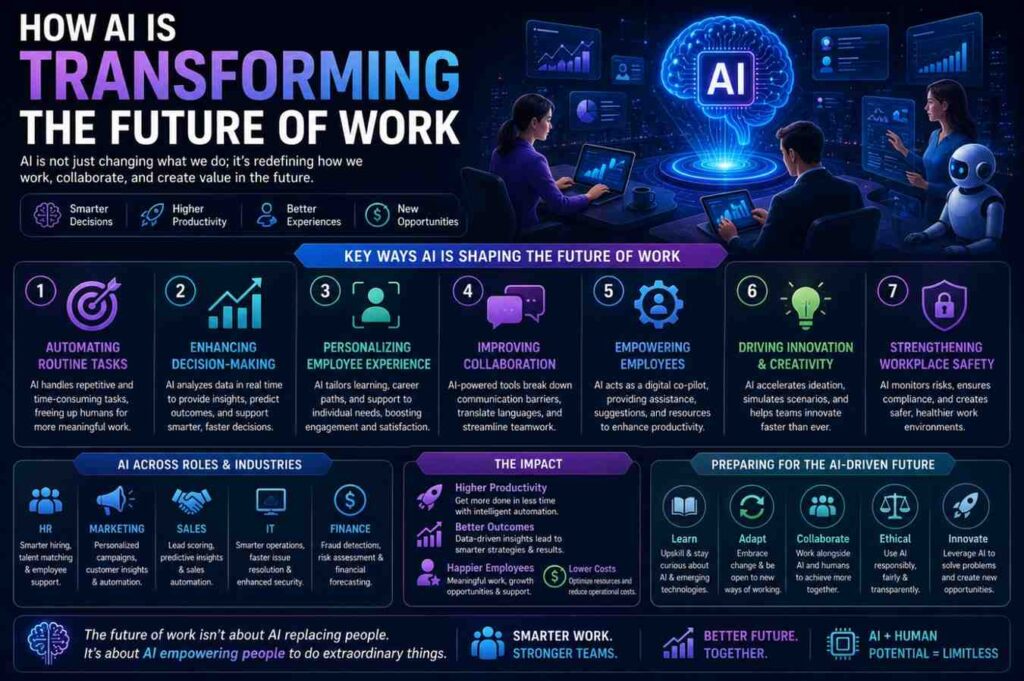
How AI is Transforming the Future of Work
Artificial Intelligence (AI) is no longer a distant innovation discussed only in research labs or science fiction—it is now deeply embedded in how modern workplaces operate. From small businesses to global enterprises, AI is reshaping workflows, decision-making processes, and even the structure of entire industries. What makes this transformation especially important is that it is not limited to automation alone; it is also enhancing human capabilities and redefining how value is created in the workplace.
In today’s digital economy, AI is being used to streamline operations, reduce repetitive tasks, and improve productivity across nearly every sector. Businesses are adopting AI-powered tools for data analysis, customer service, marketing automation, and project management. This shift allows employees to focus more on strategic thinking, creativity, and problem-solving while intelligent systems handle routine and time-consuming tasks.
Another major impact of AI is the transformation of job roles and required skill sets. Many traditional roles are evolving as AI systems take over manual and repetitive functions, while new opportunities are emerging in areas such as data science, machine learning, AI engineering, and digital strategy. This shift is encouraging continuous learning and upskilling, as professionals must adapt to remain relevant in an AI-driven workplace.
Looking ahead, the future of work will be defined by collaboration between humans and intelligent systems. Rather than replacing humans entirely, AI will act as a powerful partner that enhances decision-making, boosts efficiency, and enables innovation at scale. Organizations and individuals who embrace this change early will be better positioned to thrive in a rapidly evolving digital economy where adaptability and AI literacy are becoming essential.
Understanding How AI is Transforming the Future of Work
Artificial Intelligence is fundamentally changing the structure of modern workplaces by introducing systems that can analyze data, learn from patterns, and make decisions with minimal human intervention. This transformation is not happening in isolation; it is integrated into almost every digital tool used in businesses today. Whether it is customer service chatbots, predictive analytics dashboards, or automated scheduling systems, AI is becoming a silent yet powerful force behind daily operations.
One of the most important aspects of this transformation is efficiency. Organizations are now able to complete complex tasks in seconds that previously took hours or even days. AI-powered systems can analyze market trends, generate reports, and identify business opportunities much faster than traditional methods, significantly improving productivity while reducing costs.
At the same time, AI is changing how employees interact with technology. Instead of manually performing repetitive tasks, workers now supervise intelligent systems that handle those tasks automatically. This allows employees to focus on creative problem-solving, strategy development, and customer engagement.
As organizations continue adopting AI technologies, the workplace is evolving into a hybrid environment where human intelligence and machine intelligence work together, creating new opportunities for innovation and efficiency.
What is AI in the Workplace?
AI in the workplace refers to the integration of intelligent systems and algorithms that perform tasks traditionally requiring human intelligence, such as decision-making, language understanding, pattern recognition, and predictive analysis. These systems are designed to support employees by automating repetitive tasks and improving the speed and accuracy of business operations.
In modern organizations, AI tools are widely used in areas such as customer service chatbots, data analytics platforms, recommendation engines, and digital assistants. These technologies help businesses process large amounts of information efficiently while generating actionable insights that improve productivity and decision-making.
One of the most important benefits of AI in the workplace is personalization. AI systems can learn from user behavior and adapt over time, allowing for more efficient workflows, improved customer experiences, and smarter task management across teams and departments.
Why AI Adoption is Growing Rapidly
AI adoption is growing rapidly due to its ability to reduce costs, improve efficiency, and enhance overall business performance. Organizations are increasingly relying on AI to stay competitive in fast-changing markets where speed and data-driven decision-making are essential for success.
Another key factor driving adoption is the rise of cloud computing and AI-as-a-service platforms. These solutions allow even small and medium-sized businesses to access advanced AI capabilities without investing heavily in infrastructure or technical expertise, making AI more accessible than ever before.
As competition increases across industries, companies that fail to adopt AI risk falling behind more innovative competitors. This growing pressure is turning AI from a luxury technology into a business necessity for long-term sustainability and growth.
Human-AI Collaboration Model
The human-AI collaboration model is based on combining the strengths of both humans and intelligent systems. AI handles repetitive, data-intensive, and time-consuming tasks, while humans focus on creativity, strategy, emotional intelligence, and decision-making. This balance leads to higher productivity and better overall outcomes.
In industries such as healthcare, finance, and education, this collaboration is already making a significant impact. For example, AI can assist doctors by analyzing medical data and identifying potential conditions, while the final diagnosis and treatment decisions remain with human professionals.
This partnership between humans and AI improves accuracy, reduces errors, and speeds up workflows. As AI continues to evolve, human-AI collaboration will become even more integrated, creating workplaces that are more efficient, intelligent, and adaptive.
Automation and Its Impact on Employment
Automation powered by Artificial Intelligence is reshaping global employment patterns by replacing repetitive and routine tasks with intelligent systems. While this shift significantly improves efficiency, productivity, and accuracy in workplaces, it also raises concerns about job displacement in certain sectors. As a result, the nature of work is changing rather than disappearing entirely.
Industries such as manufacturing, logistics, retail, and customer service are experiencing some of the most visible transformations. In these sectors, AI-driven systems and robotic process automation are streamlining operations, reducing manual effort, and enabling businesses to operate at a faster and more scalable level than ever before.
| Work Area / Task Type | AI Role | Human Role | Impact Level | Example |
|---|---|---|---|---|
| Data Entry & Processing | Fully automated using AI systems | Minimal supervision | High impact (automation-heavy) | Payroll systems, form processing |
| Customer Support | AI chatbots handle basic queries | Humans handle complex issues | Medium impact | Chatbots in websites & apps |
| Decision Making | AI provides insights & predictions | Humans make final decisions | Collaborative | Business forecasting tools |
| Creative Work | AI assists with ideas & content | Humans lead creativity | Low–Medium impact | Marketing campaigns, content writing |
| Manufacturing | Robotics handle repetitive tasks | Human oversight & maintenance | High impact | Assembly lines, packaging |
| Healthcare Diagnostics | AI detects patterns in scans | Doctors confirm diagnosis | Collaborative | Radiology AI tools |
Tasks Most Affected by Automation
Repetitive and rule-based tasks are the most affected by automation technologies. Activities such as data entry, payroll processing, scheduling, invoice management, and basic customer support are increasingly being handled by AI systems and software automation tools. These tasks are highly structured, making them easier to automate with minimal human intervention.
In manufacturing environments, robots and automated systems are widely used for assembly line operations, quality control, and packaging processes. Similarly, in office environments, AI tools manage document processing, report generation, and workflow coordination, reducing the need for manual effort and improving operational efficiency.
Job Creation vs Job Displacement
While automation does lead to the reduction of certain traditional roles, it also creates a wide range of new job opportunities. Roles such as AI engineers, data scientists, machine learning specialists, and automation consultants are in high demand as organizations adopt more intelligent systems.
In addition to highly technical positions, new roles are also emerging in AI training, system supervision, digital transformation management, and ethical oversight. These positions require a combination of technical knowledge, analytical thinking, and strategic understanding, reflecting the evolving nature of modern employment.
Industry-Level Transformation
Multiple industries are undergoing significant transformation due to the integration of AI and automation technologies. In manufacturing, AI improves production efficiency and quality control. In healthcare, it enhances diagnostics and patient care. In finance, it strengthens fraud detection and risk assessment.
Retail and e-commerce sectors are also benefiting from AI-driven personalization, inventory management, and customer behavior analysis. Across all these industries, automation is not only improving efficiency but also enabling more data-driven decision-making and innovation at scale.
Skills Needed in an AI-Driven Workforce
The AI-driven economy demands a strong combination of technical expertise and soft skills. As artificial intelligence continues to automate routine tasks, human workers are increasingly required to focus on areas that involve judgment, creativity, and adaptability. This shift means that continuous skill development is no longer optional but essential for long-term career growth.
In an AI-powered workplace, professionals must constantly upgrade their abilities to stay relevant. Organizations are also investing in training programs and reskilling initiatives to help employees adapt to new technologies. This creates a dynamic work environment where learning and flexibility play a central role in success.
| Skill Category | Specific Skills | Why It Matters | Difficulty Level | Industry Use |
|---|---|---|---|---|
| Digital Literacy | Basic AI tools, software usage | Helps adapt to modern workplaces | Easy | All industries |
| Data Skills | Data analysis, visualization | Helps in decision-making | Medium | Business, Finance, Marketing |
| Technical Skills | Coding, machine learning basics | Needed for AI development roles | Hard | Tech, Engineering |
| Creative Thinking | Innovation, problem-solving | AI cannot fully replace creativity | Medium | Marketing, Design |
| Emotional Intelligence | Communication, teamwork | Improves human-AI collaboration | Easy–Medium | HR, Leadership |
| Adaptability | Continuous learning, flexibility | Essential for future job survival | Easy | All industries |
Digital and Technical Skills
Digital and technical skills are becoming increasingly important across nearly all industries. Skills such as data analysis, basic programming, and familiarity with AI-powered tools are now valuable even in non-technical roles. These capabilities help employees understand and interact effectively with intelligent systems.
In addition, knowledge of automation tools, cloud platforms, and data-driven decision-making processes is becoming essential. Employees who can work alongside AI systems and interpret data insights are more likely to remain competitive in the evolving job market.
Soft Skills That Matter More
As AI takes over more technical and repetitive tasks, soft skills are becoming even more valuable. Creativity, communication, emotional intelligence, and critical thinking are key human strengths that AI cannot easily replicate. These skills allow employees to solve complex problems and collaborate effectively.
Soft skills also play a crucial role in leadership, teamwork, and innovation. In an AI-driven workplace, the ability to think critically and adapt to changing situations often determines long-term success more than technical knowledge alone.
Continuous Learning and Reskilling
Continuous learning has become a fundamental requirement in the AI-driven workforce. Professionals must regularly update their skills to keep pace with rapidly evolving technologies and industry demands. This includes enrolling in online courses, earning certifications, and gaining hands-on experience with new tools.
Reskilling is especially important for workers whose roles are being transformed by automation. By continuously learning and adapting, individuals can transition into new roles and remain valuable in an increasingly digital economy.
Frequently Asked Questions
Frequently Asked Questions (FAQs) provide quick and easy answers to the most common doubts about the topic. This section is designed to help readers understand key ideas without needing to read the full content in detail, making it especially useful for quick revision and clarity.
In the context of an AI-driven workforce, FAQs summarize important concerns such as job impact, required skills, productivity changes, and safety considerations. They help simplify complex concepts and provide practical insights into how AI is transforming the future of work.
Will AI replace human jobs completely?
AI will not completely replace human jobs, but it will significantly transform the nature of work. Most repetitive and routine tasks will be automated, while humans will continue to play a key role in areas that require creativity, emotional intelligence, and complex decision-making.
Rather than eliminating employment, AI is expected to reshape job roles and create new opportunities in emerging fields such as data science, AI development, and digital strategy.
Which jobs are most affected by AI?
Jobs that involve repetitive, predictable, and rule-based tasks are the most affected by AI. This includes roles such as data entry, customer service support, administrative work, and basic reporting tasks.
Industries like manufacturing, retail, and logistics are also heavily impacted, as many of their operational processes are increasingly automated using AI-powered systems and robotics.
How does AI improve workplace productivity?
AI improves workplace productivity by automating time-consuming tasks, reducing human error, and streamlining workflows. This allows employees to focus on higher-value work such as strategy, innovation, and problem-solving.
In addition, AI systems provide real-time data analysis and insights, enabling faster and more informed decision-making across organizations.
What skills are needed for the future of work?
The future workforce requires a mix of digital and soft skills. Digital literacy, data understanding, and familiarity with AI tools are becoming essential across most industries.
At the same time, soft skills such as adaptability, communication, critical thinking, and problem-solving are increasingly important because they complement AI capabilities and cannot be easily automated.
How is AI changing business decision-making?
AI is transforming business decision-making by enabling faster, data-driven, and more accurate insights. It can analyze large datasets in seconds, identify patterns, and support predictive decision-making.
This allows businesses to respond more quickly to market changes, customer behavior, and operational challenges, improving overall efficiency and competitiveness.
Is AI safe for workplace use?
AI is generally safe for workplace use when it is implemented responsibly with proper ethical guidelines, transparency, and strong data protection measures.
Organizations must ensure that AI systems are regularly monitored, unbiased, and compliant with privacy regulations to minimize risks and maintain trust in automated decision-making systems.
Conclusion
AI is fundamentally reshaping how work is done, how industries operate, and how employees develop their careers. The shift is not about replacing humans but about enhancing human potential through intelligent systems that improve efficiency, decision-making, and productivity across all sectors.
As organizations continue to integrate AI into everyday workflows, the nature of jobs will evolve, creating new opportunities while transforming existing roles. This transition requires individuals and businesses to remain flexible, forward-thinking, and open to continuous change.
Ultimately, success in an AI-driven world depends on the ability to adapt, reskill, and embrace new technologies. Those who actively learn and evolve alongside AI will be best positioned to thrive in the future of work.