
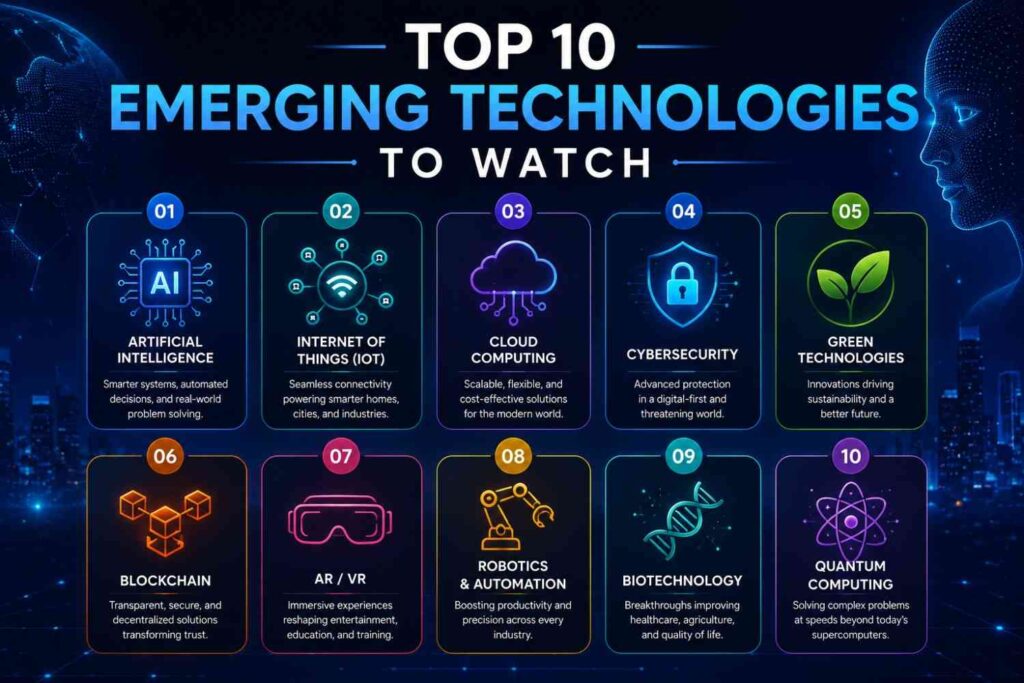
Top 10 Emerging Technologies to Watch
Technology is no longer changing slowly. It is reshaping how people work, how companies operate, how doctors treat patients, how energy is produced, and how digital trust is protected. That is why understanding the Top 10 Emerging Technologies to Watch is important for business owners, marketers, students, investors, and decision-makers.
This article explains the most important emerging technologies in simple language. It does not focus on hype. Instead, it looks at technologies that are showing real progress, practical use cases, and long-term industry impact.
If you are planning content, business strategy, digital transformation, or future skills development, this guide will help you understand which technologies deserve attention and why.
Why Emerging Technologies Matter for the Future
Emerging technologies matter because they often create the next major shift in business and society. A technology that looks experimental today can become a standard tool in a few years. Artificial intelligence is the best example. It moved from research labs into search engines, customer support, marketing, coding, healthcare, and business operations.
For companies, watching future technology trends is not only about curiosity. It is about preparation. Businesses that understand new technologies early can train teams, test tools, reduce risk, and make smarter investment decisions. Those that ignore change often react too late.
What Makes a Technology “Emerging”?
An emerging technology is a new or fast-developing technology with the potential to create major change. It may not be fully mature yet, but it shows strong signs of future impact.
A technology becomes worth watching when it meets a few conditions. It should solve a real problem, attract research or investment, show early adoption, and have a clear path toward practical use. For example, quantum computing is still early, but it is important because it may later help solve problems that are difficult for classical computers.
Why Businesses Should Track Technology Trends Early
Businesses should track emerging technologies early because early awareness reduces future pressure. A company does not need to adopt every new tool immediately, but it should understand what is coming.
In my experience, the best companies do three things. They watch trends, test small use cases, and build internal skills before the market forces them to change. This makes adoption smoother and less risky.
Top 10 Emerging Technologies to Watch in 2026
The Top 10 Emerging Technologies to Watch in 2026 are selected because they have strong relevance across business, healthcare, cybersecurity, energy, software, and digital experiences. Some are already being used at scale. Others are still developing but may become highly influential within the next three to five years.
The goal of this section is to explain each technology clearly. I will cover what it means, why it matters, and where it may create practical value.
1. Agentic AI and Multiagent Systems
Agentic AI refers to AI systems that can plan, decide, use tools, and complete tasks with less human prompting. Unlike a basic chatbot that only responds to questions, an AI agent can help manage workflows, summarize reports, research competitors, schedule tasks, or coordinate with other digital tools.
Multiagent systems take this further. They involve several AI agents working together on different parts of a task. For example, one agent may research data, another may analyze it, and another may prepare a report.
This is one of the most important emerging technologies because it can change daily business operations. However, companies must use it carefully. Human review, data security, permissions, and clear rules are essential.
2. AI-Native Software Development
AI-native software development means using artificial intelligence throughout the software creation process. This includes planning, coding, testing, debugging, documentation, and quality checks.
This technology is important because software teams are under pressure to build faster without reducing quality. AI can help developers write code, find bugs, generate test cases, and explain technical problems. It can also help non-technical teams create simple tools faster.
Still, AI-generated code should never be trusted blindly. Businesses need review processes, secure development practices, and proper testing. AI can support developers, but it should not replace professional judgment.
3. Quantum Computing
Quantum computing uses quantum physics to process information differently from traditional computers. It is not designed to replace laptops or normal servers. Instead, it may help solve complex problems in areas such as chemistry, materials science, logistics, finance, and drug discovery.
For most businesses, quantum computing is not a tool they need today. But it is still one of the top technology trends to watch because it may create powerful advantages in the future.
Business leaders should pay attention to quantum progress, especially if they work in industries that depend on simulation, optimization, or advanced research.
Cybersecurity and Trust Technologies Are Becoming More Important
As digital systems become more advanced, trust becomes harder to maintain. AI-generated content, cyberattacks, deepfakes, data leaks, and future quantum risks are all creating new security challenges.
This is why cybersecurity and trust-based technologies are now central to digital transformation. Companies cannot only focus on speed and automation. They also need to protect data, verify identity, and prove that digital content is authentic.
4. Post-Quantum Cryptography
Post-quantum cryptography is designed to protect digital information from future quantum computers that may break some current encryption systems. This does not mean current encryption will fail tomorrow. It means organizations should start preparing now.
This technology matters most for banks, healthcare companies, governments, SaaS companies, and businesses that store sensitive long-term data. If data must remain private for many years, future quantum threats should be part of cybersecurity planning.
A practical first step is to identify where encryption is used across websites, apps, databases, and internal systems. After that, companies can plan migration carefully.
5. AI Security and Digital Provenance
AI security focuses on protecting AI systems from misuse, unsafe outputs, data leaks, model attacks, and unauthorized access. As companies use AI more often, they need stronger controls around how AI tools access information and make decisions.
Digital provenance helps verify the origin and history of digital content. This is becoming important because AI can generate realistic images, videos, voice recordings, and documents. Businesses need ways to prove what is real and what has been changed.
For brands, digital trust is now a business asset. Customers, partners, and regulators will expect stronger proof of authenticity.
Healthcare and Biotech Technologies Are Changing Human Life
Healthcare and biotechnology are among the most meaningful areas of innovation. These technologies can improve diagnosis, treatment, drug development, and disease prevention. They also raise serious ethical and safety questions.
This section is important because healthcare technology affects real people directly. Unlike simple business automation, mistakes in health technology can affect patient safety. That is why governance, testing, medical oversight, and ethical use are essential.
6. AI in Healthcare
AI in healthcare can support medical imaging, diagnosis assistance, patient triage, clinical documentation, hospital operations, and drug discovery. It can help doctors and healthcare teams process large amounts of information faster.
However, AI should be treated as support, not as a replacement for qualified medical professionals. Medical decisions require human responsibility, clinical judgment, and patient context.
I recommend healthcare organizations focus on safe use cases first. Examples include admin support, appointment management, documentation, and image review assistance under professional supervision.
7. Synthetic Biology and Engineered Therapeutics
Synthetic biology combines biology, engineering, computing, and design. It allows scientists to create or modify biological systems for useful purposes. Engineered therapeutics include advanced treatments designed to target disease more precisely.
This area may influence medicine, agriculture, climate solutions, and materials. It is especially important in areas such as gene editing, cell therapy, and personalized medicine.
At the same time, this technology must be handled carefully. Safety testing, ethical review, regulation, and public trust are essential because biotechnology directly affects living systems.
Industrial and Energy Technologies Will Reshape Physical Industries
Technology is not only about software. Some of the most important emerging technologies are changing factories, transport, warehouses, energy systems, and infrastructure.
This matters because physical industries often face labor shortages, high energy costs, safety risks, and supply chain pressure. Robotics, automation, and clean energy systems can help solve these problems when implemented correctly.
8. Physical AI, Robotics, and Autonomous Systems
Physical AI means artificial intelligence used in machines that operate in the real world. This includes robots, drones, autonomous vehicles, warehouse systems, factory machines, and medical robotics.
The value is clear. These systems can improve speed, safety, accuracy, and productivity. For example, warehouses can use robots to move goods, while factories can use smart machines for quality control.
The best way to adopt robotics is to start small. Businesses should choose one workflow, measure results, train staff, and then expand if the system proves reliable.
9. Clean Energy Technology and Battery Storage
Clean energy technology includes solar power, wind power, battery storage, smarter grids, green hydrogen, and energy management systems. These technologies are becoming more important as businesses try to reduce energy risk and improve sustainability.
Battery storage is especially important because solar and wind power are not always available at the same time demand is high. Storage helps balance energy supply and demand.
For businesses, clean energy technology is not only about environmental responsibility. It can also support cost control, energy security, and long-term resilience.
Digital Experience Technologies Are Changing How People Interact
Digital experiences are becoming more immersive, personalized, and intelligent. People are no longer interacting with technology only through screens, keyboards, and basic websites. They are using voice search, AI assistants, mixed reality, smart devices, and personalized platforms.
This shift matters for brands, educators, retailers, healthcare providers, and service businesses. The companies that understand new digital experience trends can create better customer journeys and more engaging content.
10. Spatial Computing and Immersive Interfaces
Spatial computing connects digital content with physical space. It includes augmented reality, virtual reality, mixed reality, 3D environments, and digital twins.
This technology can be useful in training, product design, education, healthcare simulation, architecture, real estate, and industrial planning. For example, a company can train workers in a simulated environment before placing them in a high-risk workplace.
Spatial computing is still developing, but it is worth watching because it changes how people learn, collaborate, and experience information.
Voice Search and Conversational Interfaces
Voice search and conversational interfaces are also part of the future digital experience. People increasingly expect answers in natural language instead of long menus or complicated search pages.
This is important for AEO and GEO content strategy. Articles should answer questions clearly, define terms, and include structured information that search engines and AI systems can understand.
For content teams, this means writing helpful answers first and optimizing keywords second.
Comparison Table of Emerging Technologies
A comparison table helps readers quickly understand which technologies are mature, which are still developing, and where each one may be useful. This is helpful for business owners who need to prioritize.
The table below gives a practical view of each technology. It is not a final investment guide, but it can help readers decide which topics deserve deeper research.
Emerging Technology Comparison
| Technology | Main Use Case | Business Value | Adoption Readiness |
|---|---|---|---|
| Agentic AI | Workflow automation | Saves time and improves productivity | High |
| AI-native development | Software creation | Speeds up coding and testing | High |
| Quantum computing | Complex simulations | Future research advantage | Low to medium |
| Post-quantum cryptography | Data security | Protects future-sensitive data | Medium |
| AI security | Safe AI adoption | Reduces digital and operational risk | High |
| AI in healthcare | Clinical and admin support | Improves healthcare efficiency | Medium |
| Synthetic biology | Advanced medicine and biology | Supports new treatments | Medium |
| Robotics and physical AI | Industrial automation | Improves speed and safety | Medium to high |
| Clean energy technology | Energy systems | Reduces energy risk | High |
| Spatial computing | Immersive experiences | Improves training and visualization | Medium |
How to Choose the Right Technology to Follow
The right technology depends on your business goals. If your main issue is productivity, start with AI automation. If your concern is data protection, focus on AI security and post-quantum cryptography. If you work in manufacturing or logistics, robotics may be more relevant.
The smartest approach is to connect technology with a real problem. Do not invest only because a trend is popular. Test small, measure results, and scale only when the value is clear.
How Businesses Can Prepare for Emerging Technologies
Knowing the Top 10 Emerging Technologies to Watch is useful, but preparation is more important. Many companies fail with new technology because they adopt tools without a clear plan, proper training, or measurable goals.
A professional technology strategy should include research, small pilots, risk review, team training, and performance tracking. This makes adoption safer and more useful.
Step-by-Step Readiness Plan
Start by listing the biggest problems in your business. These may include slow operations, rising costs, poor customer service, security concerns, or manual workflows.
Next, match each problem with a possible technology solution. For example, AI agents may help with repetitive admin tasks, while clean energy systems may help reduce energy risk.
Then run a small pilot. Measure time saved, cost impact, user feedback, and risk. If the results are strong, expand gradually.
Skills Teams Should Build Now
Teams should build skills in AI literacy, data management, cybersecurity awareness, digital ethics, automation planning, and vendor evaluation.
Leaders do not need to become technical experts in every field. But they should understand enough to ask smart questions. The future will reward companies that combine technology knowledge with practical business judgment.
Frequently Asked Questions
This FAQ section answers common user questions in a clear and direct way. These questions are useful for search intent, voice search, AEO optimization, and generative search visibility.
Quick Answer About Top 10 Emerging Technologies to Watch
The Top 10 Emerging Technologies to Watch include agentic AI, AI-native software development, quantum computing, post-quantum cryptography, AI security, physical AI and robotics, synthetic biology, AI in healthcare, clean energy technology, and spatial computing. These technologies are important because they are moving from research labs and early testing into real business, healthcare, cybersecurity, manufacturing, energy, and consumer experiences. In my experience, the best approach is not to follow every trend blindly. Businesses should first understand the use case, risk, adoption cost, and long-term value before investing.
What are the Top 10 Emerging Technologies to Watch?
The Top 10 Emerging Technologies to Watch include agentic AI, AI-native software development, quantum computing, post-quantum cryptography, AI security, AI in healthcare, synthetic biology, robotics, clean energy technology, and spatial computing. These technologies can affect business, healthcare, cybersecurity, energy, and digital experiences.
Which emerging technology will grow the fastest?
AI-related technologies are likely to grow quickly because they already have strong business use cases. Agentic AI, AI-native development, and AI security are especially important. However, growth depends on trust, regulation, cost, and how safely companies can use these tools.
Is quantum computing useful for businesses today?
Quantum computing is still early for most businesses. It is not something every company needs today. However, industries such as pharmaceuticals, finance, logistics, and advanced manufacturing should watch it closely because it may later solve complex problems faster.
Why is post-quantum cryptography important?
Post-quantum cryptography is important because future quantum computers may challenge some current encryption methods. Businesses that store sensitive long-term data should start reviewing their systems and planning future security upgrades.
How can small businesses use emerging technologies?
Small businesses can start with practical tools such as AI automation, cybersecurity improvements, analytics, and energy efficiency. They do not need to adopt every advanced technology. A small, focused pilot project is usually the safest way to begin.
Are emerging technologies risky?
Yes, emerging technologies can involve risks such as privacy issues, bias, security gaps, high costs, and unclear regulation. Businesses should test carefully, protect data, keep humans involved, and review legal or ethical concerns before scaling.
Conclusion
The Top 10 Emerging Technologies to Watch show where the future of business, healthcare, cybersecurity, energy, and digital experience is heading. Some technologies, such as AI agents and AI-native development, are already becoming practical. Others, such as quantum computing and synthetic biology, may take longer but could create major change.
The best strategy is not to chase every trend. It is to understand which emerging technologies connect with your goals, risks, customers, and industry. Start with small tests, measure results, and build skills before making large investments.